Taste Modulators: Revolutionizing the Food and Beverage Industry

The taste modulators market is projected to reach USD 2.0 billion by 2028 from USD 1.4 billion by 2023, at a CAGR of 7.4% during the forecast period in terms of value. The taste modulators market is growing due to rising health consciousness, addressing the demand for healthier options by reducing sugar, salt, and fat. The surge in obesity and diabetes cases fuels the need for sugar-free and reduced-calorie products, often utilizing taste modulators. Ongoing innovation and the versatility of taste modulators contribute to their widespread application in diverse food and beverage products.

Download PDF brochure: https://www.marketsandmarkets.com/pdfdownloadNew.asp?id=169998886

North America dominated the Taste Modulators market during the study period

The presence of key players such as Ingredion (US), Sensient Technologies Corporation(US), Cargill, Incorporated (US), ADM (US), International Flavors & Fragrances Inc. (US), Icon Foods (US), and Carmi Flavor & Fragrance Co., Inc. (US) underscores North America’s dominance in the Taste Modulators market. These industry leaders strategically align with the region’s dynamic trends, where the surge in demand for clean-label and plant-based products has become increasingly evident. The region benefits from advanced taste modulation technologies, responding to the rising consumer demand for healthier food options. Heightened awareness of health-conscious choices among North American consumers propels the market’s growth. Additionally, the region’s food industry exhibits a proactive approach to aligning products with evolving preferences, emphasizing reduced sugar, salt, and fat. The strategic response to these trends, coupled with an established infrastructure supporting innovation, positions North America as a leader in the taste modulators market.

Key players in this market include DSM (Netherlands), International Flavors & Fragrances Inc. (US), Givaudan (Switzerland), Kerry Group PLC (Ireland), Ingredion (US), Symrise (Germany), Sensient Technologies Corporation (US), Tate & Lyle (UK), Corbion (Netherlands), Takasago International Corporation (Japan), Icon Foods (US), Carmi Flavor & Fragrance Co., Inc. (US), Cargill Incorporated (US), MANE (France), and ADM (US).

The taste modulator market is expanding, propelled by global culinary exploration and technological advancements

The taste modulator market is poised for significant future growth, propelled by a convergence of factors. A primary driver is the escalating consumer interest in global cuisines and exotic flavors, fostering a heightened demand for taste modulators. Consumers increasingly seek diverse and adventurous culinary experiences, prompting the food industry to explore innovative solutions for flavor enhancement. Concurrently, continuous advancements in taste modulation technologies stand as a cornerstone for market expansion. These technological strides inspire product innovation, facilitating a broader spectrum of applications across various food and beverage categories. This evolution aligns with the rising consumer preference for healthier choices, as taste modulators contribute to reducing sugar, salt, and fat content while enhancing flavors. The harmonious interplay between evolving consumer tastes and cutting-edge technology positions the taste modulator market at the forefront of catering to dynamic industry demands, ensuring a future characterized by versatile, health-conscious, and captivating culinary offerings.

Make an Inquiry: https://www.marketsandmarkets.com/Enquiry_Before_BuyingNew.asp?id=169998886

In Taste Modulators, the surge in sugar substitutes is driven by health-conscious consumers and industry innovation

The dominance of sweet modulators in the taste modulators market is underscored by an escalating imperative for reduced sugar formulations driven by heightened health-conscious consumer preferences. This trend signifies a strategic response to global health concerns, particularly obesity and diabetes, with sweet modulators serving as key enablers for the development of low-calorie and reduced-sugar products while maintaining an optimal taste profile. Within this landscape, the food industry’s unwavering commitment to meet evolving consumer expectations further solidifies the pivotal role of sweet modulators. Their prominence is not merely a reflection of current trends but a strategic imperative in product reformulations and driving innovation across a spectrum of applications.
Exploring the Growth Potential of the Global Taste Modulators Market

The taste modulators market is projected to reach USD 2.0 billion by 2028 from USD 1.4 billion by 2023, at a CAGR of 7.4% during the forecast period in terms of value. The taste modulators market is growing due to rising health consciousness, addressing the demand for healthier options by reducing sugar, salt, and fat. The surge in obesity and diabetes cases fuels the need for sugar-free and reduced-calorie products, often utilizing taste modulators. Ongoing innovation and the versatility of taste modulators contribute to their widespread application in diverse food and beverage products.

Download PDF brochure: https://www.marketsandmarkets.com/pdfdownloadNew.asp?id=169998886

Asia Pacific is poised to experience the highest CAGR in the Taste modulators market during the forecast period

The region’s remarkable economic growth has led to increased consumer purchasing power, which, in turn, has boosted demand for processed foods and beverages. The escalating urbanization and evolving dietary preferences in the region play a pivotal role in propelling the adoption of taste modulators. Consumers’ heightened preference for healthier food options, coupled with the proactive response from regional food manufacturers, propels the demand for taste modulation technologies. The robust food processing industry and the emergence of innovative culinary concepts further fuel the widespread incorporation of taste modulators across diverse food and beverage categories. As Asia Pacific aligns with global health trends, emphasizing reduced sugar, salt, and fat content, the demand for taste modulators is set to witness a substantial upswing. These factors collectively position Asia Pacific as a pivotal driver for the anticipated robust growth in the taste modulators market during the forecast period.

Key Players in the Market

Key players in this market include DSM (Netherlands), International Flavors & Fragrances Inc. (US), Givaudan (Switzerland), Kerry Group PLC (Ireland), Ingredion (US), Symrise (Germany), Sensient Technologies Corporation (US), Tate & Lyle (UK), Corbion (Netherlands), Takasago International Corporation (Japan), Icon Foods (US), Carmi Flavor & Fragrance Co., Inc. (US), Cargill Incorporated (US), MANE (France), and ADM (US).

The taste modulator market is expanding, propelled by global culinary exploration and technological advancements

The taste modulator market is poised for significant future growth, propelled by a convergence of factors. A primary driver is the escalating consumer interest in global cuisines and exotic flavors, fostering a heightened demand for taste modulators. Consumers increasingly seek diverse and adventurous culinary experiences, prompting the food industry to explore innovative solutions for flavor enhancement. Concurrently, continuous advancements in taste modulation technologies stand as a cornerstone for market expansion. These technological strides inspire product innovation, facilitating a broader spectrum of applications across various food and beverage categories. This evolution aligns with the rising consumer preference for healthier choices, as taste modulators contribute to reducing sugar, salt, and fat content while enhancing flavors. The harmonious interplay between evolving consumer tastes and cutting-edge technology positions the taste modulator market at the forefront of catering to dynamic industry demands, ensuring a future characterized by versatile, health-conscious, and captivating culinary offerings.

Make an Inquiry: https://www.marketsandmarkets.com/Enquiry_Before_BuyingNew.asp?id=169998886

In Taste Modulators, the surge in sugar substitutes is driven by health-conscious consumers and industry innovation

The dominance of sweet modulators in the taste modulators market is underscored by an escalating imperative for reduced sugar formulations driven by heightened health-conscious consumer preferences. This trend signifies a strategic response to global health concerns, particularly obesity and diabetes, with sweet modulators serving as key enablers for the development of low-calorie and reduced-sugar products while maintaining an optimal taste profile. Within this landscape, the food industry’s unwavering commitment to meet evolving consumer expectations further solidifies the pivotal role of sweet modulators. Their prominence is not merely a reflection of current trends but a strategic imperative in product reformulations and driving innovation across a spectrum of applications.

Taste Modulators Market: Size, Share, Future Outlook

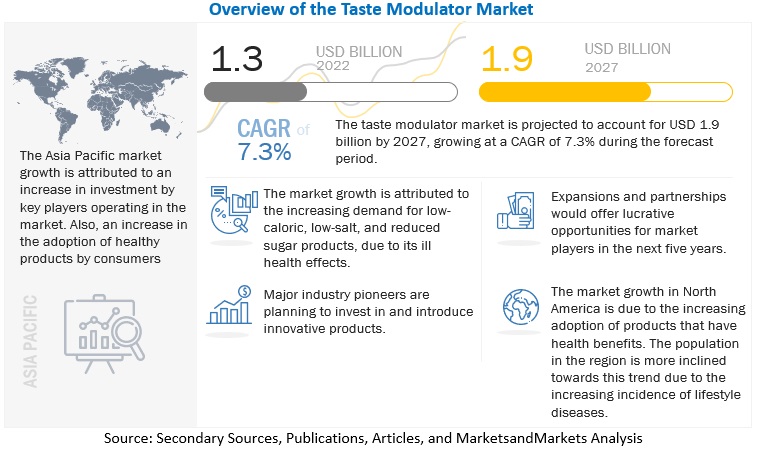
The taste modulators market size is expected to reach USD 2.0 billion in 2028 from USD 1.4 billion in 2023, at a CAGR of 7.4% during the forecast period. The taste modulators market is growing due to rising health consciousness, addressing the demand for healthier options by reducing sugar, salt, and fat. The surge in obesity and diabetes cases fuels the need for sugar-free and reduced-calorie products, often utilizing taste modulators.

Some key factors driving the taste modulators market growth: 

  • Rising health awareness
  • Low-calorie and low-sugar trends
  • Functional food and beverage demands
  • Sugar taxes and regulations
  • Innovation in taste modulator development

To know about the assumptions considered for the study download the pdf brochure

Rising health awareness:

  • Consumers are increasingly concerned about their health and well-being, leading to a demand for healthier food and beverage options. Taste modulators allow manufacturers to reduce sugar, fat, and salt content in their products without sacrificing taste, catering to this health-conscious market segment.

Low-calorie and low-sugar trends:

  • The growing popularity of low-calorie and low-sugar diets is propelling the taste modulators market. These ingredients help maintain sweetness and palatability in reduced-sugar products.

Functional food and beverage demands: 

  • Functional foods and beverages that offer health benefits are gaining traction. Taste modulators play a role in enhancing the flavor of these products while maintaining their functionality.

Sugar taxes and regulations:

  • Governments around the world are implementing sugar taxes and regulations to curb sugar consumption. This is prompting beverage manufacturers to use taste modulators to create reduced-sugar drinks.

Innovation in taste modulator development:

  • Continuous research and development efforts are leading to the creation of new and improved taste modulators. These advancements offer manufacturers greater flexibility in formulating healthier products.

Overall, the taste modulators market is expected to witness continued growth in the coming years, driven by the aforementioned factors.

Taste Modulators Market Share – Global Industry Landscape

The taste modulators market is characterized by the presence of several key players competing for market share. Some of the leading companies in the taste modulators industry include:

  • DSM (Netherlands)
  • IFF (US)
  • Givaudan (Switzerland)
  • Kerry Group PLC (Ireland)
  • Ingredion (US)
  • Symrise (Germany)

These industry leaders strategically align with the region’s dynamic trends, where the surge in demand for clean-label and plant-based products has become increasingly evident.

Speak to Analyst: https://www.marketsandmarkets.com/speaktoanalystNew.asp?id=169998886

DSM (Netherlands)

  • Market Share: DSM, headquartered in the Netherlands, is a global science-based company with a focus on health, nutrition, and sustainable living. It holds a significant market share in various sectors including nutrition, personal care, pharmaceuticals, and materials.
  • Key Offerings: DSM offers a wide range of products and solutions including vitamins, nutritional ingredients, food and beverage ingredients, pharmaceuticals, personal care ingredients, and materials for various industries.

IFF (International Flavors & Fragrances Inc.) (US)

  • Market Share: IFF, based in the United States, is a leading global creator of flavors and fragrances. It has a notable market share in the flavors and fragrances industry worldwide.
  • Key Offerings: IFF provides a diverse portfolio of flavors, fragrances, and ingredients for various consumer products including food and beverages, beauty and personal care products, household goods, and more.

Givaudan (Switzerland)

  • Market Share: Givaudan, headquartered in Switzerland, is one of the largest manufacturers of flavors and fragrances globally. It commands a significant market share in the flavors and fragrances industry.
  • Key Offerings: Givaudan offers a comprehensive range of flavors, fragrances, and active cosmetic ingredients for use in food and beverage products, personal care products, household goods, and fine fragrances.

Kerry Group PLC (Ireland)

  • Market Share: Kerry Group, based in Ireland, is a major player in the global food ingredients and flavorings market. It holds a substantial market share in the food and beverage industry.
  • Key Offerings: Kerry Group provides a wide array of food and beverage ingredients, flavors, seasonings, and functional ingredients for various applications including dairy, meat, snacks, beverages, and bakery products.

Ingredion (US)

  • Market Share: Ingredion, headquartered in the United States, is a leading global ingredient solutions provider primarily serving the food, beverage, and industrial markets. It holds a significant market share in the food ingredient industry.
  • Key Offerings: Ingredion offers a broad portfolio of ingredient solutions including starches, sweeteners, texturizers, nutrition ingredients, and biomaterials for use in food and beverage products, as well as industrial applications.

Symrise (Germany)

  • Market Share: Symrise, based in Germany, is a major player in the flavors and fragrances industry globally. It commands a considerable market share in this sector.
  • Key Offerings: Symrise provides a diverse range of flavors, fragrances, cosmetic ingredients, and aroma molecules for use in various consumer products including food and beverages, personal care products, fine fragrances, and household goods.

Unlocking the Potential: Exploring the Growth Trajectory of the Taste Modulators Market

The taste modulators market is on a trajectory of significant growth, poised to reach USD 2.0 billion by 2028 from USD 1.4 billion in 2023, reflecting a remarkable Compound Annual Growth Rate (CAGR) of 7.4%. This expansion is driven by a multitude of factors, primarily the escalating health consciousness among consumers. With a collective aim to address health concerns such as obesity and diabetes, the demand for healthier alternatives has surged. Taste modulators, by reducing sugar, salt, and fat content while enhancing flavors, have emerged as pivotal solutions in catering to these evolving preferences.

Download PDF brochure: https://www.marketsandmarkets.com/pdfdownloadNew.asp?id=169998886

Culinary Exploration and Technological Advancements: Catalysts of Growth

One of the driving forces behind the expanding taste modulator market is the global exploration of culinary delights coupled with advancements in technology. As consumers increasingly seek diverse and adventurous culinary experiences, the food industry is compelled to innovate. Continuous advancements in taste modulation technologies facilitate product innovation, thereby widening the spectrum of applications across various food and beverage categories. This evolution aligns seamlessly with the rising preference for healthier choices, thus paving the way for a future characterized by versatile, health-conscious, and captivating culinary offerings.

Asia Pacific Emergence: A Hub of Innovation

The Asia Pacific region is witnessing a significant upswing in the taste modulators market, propelled by the region’s robust food and beverage industry evolution. Countries like India and China, with their rich culinary heritage, are at the forefront of this transformation. Leveraging taste modulators, these nations are aligning traditional cuisines with contemporary health-conscious trends. This convergence not only fuels local markets but also establishes the Asia Pacific region as a focal point for taste modulator innovations, reflecting a harmonious blend of tradition and innovation in the evolving food landscape.

Sweet Modulators: Meeting Health-Conscious Demands

Within the taste modulators landscape, the surge in sugar substitutes is particularly noteworthy. Driven by health-conscious consumers and industry innovation, sweet modulators have gained prominence. These substitutes serve as key enablers for the development of low-calorie and reduced-sugar products while maintaining an optimal taste profile. Industry leaders like Cargill Incorporated are strategically innovating with sweet modulator solutions, exemplifying the sector’s dedication to offering natural and clean-label alternatives. Such initiatives underscore the dominance of sweet modulators in the taste modulators market and their pivotal role in driving innovation towards healthier and flavorful choices.

Speak to Analyst: https://www.marketsandmarkets.com/speaktoanalystNew.asp?id=169998886

North America: Leading the Way

Throughout the study period, North America has emerged as the dominant force in the taste modulators market. Key players strategically align with dynamic trends in the region, emphasizing clean-label and plant-based products. Advanced taste modulation technologies respond effectively to the rising consumer demand for healthier food options. With heightened awareness of health-conscious choices, North American consumers drive market growth. The proactive approach of the region’s food industry in aligning products with evolving preferences positions North America as a leader in the taste modulators market.

Conclusion

As taste modulators continue to revolutionize the food and beverage industry, their role in meeting evolving consumer preferences for healthier options cannot be overstated. With innovation at its core, the market is poised for remarkable growth, driven by a harmonious interplay between consumer tastes and cutting-edge technology. From addressing health concerns to fostering culinary exploration, taste modulators stand as beacons of progress in the journey towards a healthier and more flavorful future.

Increased Consumer Demand for Reduced Calorie Products With Original Taste of Sugar Drives the Market for Taste Modulators

The report Taste Modulators Market by Type (Sweet Modulators, Salt Modulators, and Fat Modulators), Application (Confectionery Products, Bakery Products, Dairy Products, Snacks & Savory Products, and Meat Products), and Region – Global Forecast to 2023″, The global taste modulators market is estimated at USD 1,084.2 million in 2018 and is projected to reach USD 1,758.7 million by 2023, at a CAGR of 10.2% during the forecast period. The market is driven by factors such as the growing awareness among consumers about the ill-effects of excessive salt intake and the increased consumer demand for low-calorie products while retaining the original taste. There has been an increasing demand for reduced/zero calorie and reduced salt products that do not compromise on the taste. This has fueled the demand for taste modulators as well.

Download PDF Brochure: https://www.marketsandmarkets.com/pdfdownloadNew.asp?id=169998886

The sweet modulators segment, by type, estimated to account for the largest market share in 2018

The sweet modulators segment is estimated to dominate the global taste modulators market in 2018. Sweet modulators provide a sweet taste with zero calories to food products. It is used by manufacturers to restore the sweet taste. Taste modulators are gaining popularity among consumers owing to enhanced taste and nutritional benefits.

The beverages segment, by application, is estimated to hold a larger share in 2018.

Beverages are broadly classified into two categories, namely, alcoholic and non-alcoholic beverages. The non-alcoholic beverages segment was the largest; it includes both carbonated drinks and non-carbonated beverages such as juices, energy drinks, sports drinks, and fortified drinks. Taste modulators are used to alter the taste and support the reduction of calories in drinks (being used in conjunction with sugar substitutes) to meet consumer demand for healthy beverage products.

Speak to Analyst: https://www.marketsandmarkets.com/speaktoanalystNew.asp?id=169998886

The Asia Pacific market is projected to grow at the highest CAGR from 2018 to 2023.

The Asia Pacific region is expected to grow at the highest CAGR during the forecast period. China and India have witnessed major growth in the taste modulators market, acquiring significant shares in the region. The region witnesses a high demand for taste modulators due to the rise in meat consumption, population growth, and increase in awareness about healthy & nutritional food products.

This report includes a study of various taste modulators, along with the product portfolios of leading companies. It includes the profiles of leading companies such as DSM (Netherlands), Kerry (Ireland), Ingredion (US), Givaudan (Switzerland), and Firmenich (Switzerland).