
Microirrigation Systems Market: Growth Drivers and Competitive Landscape

marketsandmarkets logo

The microirrigation systems market is projected to grow from USD 13.50 billion in 2025 to reach USD 21.56 billion by 2030, at a compound annual growth rate (CAGR) of 9.8% during the forecast period. The microirrigation systems market is expanding due to ongoing improvements in irrigation hardware, software, and services. Modern microirrigation systems now often include automation and smart control technologies. This allows for precise scheduling, real-time flow regulation, and consistent water distribution. These features enable farmers to optimize when and how much they irrigate, significantly reducing water waste, energy use, and reliance on labor while boosting efficiency. At the same time, advances in sensor technology, remote monitoring, and data analysis are changing irrigation from a reactive task into a proactive, data-driven process. Monitoring soil moisture, weather conditions, evaporation rates, and crop-specific water needs in real time enables growers to adjust irrigation strategies based on current field conditions. This can improve crop health, ensure more consistent yields, and increase resilience to climate change and water shortages.

Furthermore, combining fertigation systems with digital irrigation platforms enables precise nutrient delivery with water. This improves the effectiveness of fertilizers and reduces runoff, benefiting the environment. Cloud-based platforms, mobile apps, and IoT connections make these systems easier to use by providing valuable insights, alerts, and performance tracking. Together, these innovations are enhancing returns for farmers and speeding up the adoption of microirrigation systems, particularly in high-value crops, greenhouses, and areas facing water scarcity. This trend supports long-term market growth.

Download PDF Brochure: https://www.marketsandmarkets.com/pdfdownloadNew.asp?id=566

By type, the sprinkler irrigation segment is projected to be fastest growing segment.

The micro sprinkler segment is expected to be the fastest-growing within the microirrigation systems market during the forecast period, driven by its ability to balance precision, coverage, and operational efficiency. Micro sprinklers deliver uniform water distribution across fields, orchards, and gardens, and can be strategically positioned to irrigate specific zones or individual plants. This targeted coverage ensures that each plant receives adequate moisture, reducing both under- and over-irrigation and supporting healthier plant growth.

Compared with conventional sprinkler systems, micro sprinklers operate at lower pressures and flow rates, which significantly reduces energy consumption for pumping and lowers overall operating costs. They are particularly well-suited for orchards, vineyards, nurseries, and plantation crops, where wider root zones and canopy coverage are required. In addition, micro sprinklers perform well on uneven terrain and in soils with lower infiltration rates, offering greater flexibility across varied agronomic conditions. These advantages, combined with rising emphasis on water efficiency and energy savings, are accelerating the adoption of micro sprinkler systems and positioning the segment for strong growth over the forecast period.

By end user, industrial user is estimated to be the fastest-growing segment during the review period.

The industrial user segment is expected to be the fastest-growing part of the microirrigation systems market during this review period. This growth is driven by a growing focus on environmental sustainability, operational efficiency, and regulatory requirements. Industrial users, which include commercial agribusinesses, plantations, food processors with their own farms, and large institutional growers, are increasingly adopting microirrigation technologies to practice eco-friendly water management. These systems help reduce water waste, reduce fertilizer and pesticide runoff, and improve resource use. This makes them an attractive option for organizations looking to lower their environmental impact while keeping up productivity.

Technological progress is also boosting adoption among industrial users. Modern microirrigation systems can be monitored and controlled remotely through IoT-enabled platforms, mobile apps, and computer dashboards. This allows for real-time changes to irrigation schedules, flow rates, and fertigation settings. Remote access is especially useful for businesses managing large or spread-out operations. It adds convenience, improves decision-making, and lowers the need for on-site labor. As sustainability goals, cost-cutting, and digital transformation become vital to industrial operations, demand for new microirrigation solutions is likely to accelerate further.

Request Sample Pages: https://www.marketsandmarkets.com/requestsampleNew.asp?id=566

Asia Pacific is estimated to be the fastest-growing region during the study period.

The Asia Pacific region is increasingly affected by irregular rainfall patterns, prolonged droughts, and frequent heat waves, all of which are intensifying pressure on agricultural water management. Under these volatile climatic conditions, microirrigation systems play a critical role in delivering regulated and efficient water distribution, helping farms maintain productivity despite reduced or unpredictable water availability. By supplying water directly to the root zone in controlled quantities, microirrigation reduces water stress on crops and enhances their resilience to extreme weather events.

Microirrigation systems also allow farmers to fine-tune irrigation schedules and application volumes based on specific crop requirements, soil conditions, and growth stages. This level of precision enables crops to better endure and adapt to changing climatic conditions, improving survival rates and yield stability. In addition, irrigation water in some regions may contain high levels of salts, heavy metals, or other contaminants, which can negatively affect soil health and crop productivity. To address this, microirrigation systems can be equipped with filtration and purification units that remove impurities before water reaches the plants. As a result, crops receive cleaner water, leading to improved plant health, higher yields, and reduced long-term damage to soil and crop systems caused by poor water quality.

Leading Microirrigation Systems Companies:

Eminent players operating in the microirrigation systems market are Jain Irrigation Systems Ltd. (India), The Toro Company (US), Netafim (Israel), Nelson Irrigation (US), Rain Bird Corporation (US), Finolex Plasson (India), Mahindra EPC Irrigation Limited (India), T-L Irrigation (US), Hunter Industries (US), Rivulis (Israel), Chinadrip irrigation Equipment co., Ltd. (China), Elgo Irrigation Ltd. (Israel), Antelco (Australia), Microjet (South Africa), and Irritec S.p.A. (Italy), among others.
Microirrigation: A Comprehensive Market Analysis

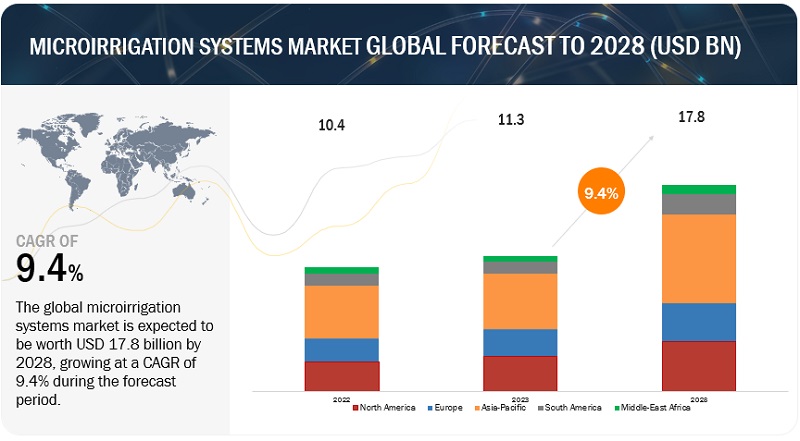
The microirrigation systems market is estimated at USD 10.4 billion in 2022 and is projected to reach USD 17.8 billion by 2028, at a CAGR of 9.4% from 2023 to 2028. Advancements in technology have significantly improved the efficiency and effectiveness of microirrigation systems. Automation and control systems allow for precise monitoring and management of water applications, ensuring optimal irrigation scheduling and reducing human error. Additionally, innovations in sensor technology, remote monitoring, and data analytics have enabled real-time monitoring of soil moisture levels, weather conditions, and crop water requirements, leading to improved irrigation management.

Download PDF brochure: https://www.marketsandmarkets.com/pdfdownloadNew.asp?id=566

Asia Pacific is estimated to be the fastest-growing region during the study period

Climate issues in the Asia Pacific area include irregular rainfall patterns, droughts, and heat waves. Microirrigation systems provide regulated and efficient water distribution, increasing resilience to severe climatic circumstances. Farmers may tune irrigation schedules and water applications to individual crop demands, allowing crops to endure and adapt to changing climatic circumstances. In some areas, irrigation water may include excessive quantities of salts, heavy metals, or other impurities. To eliminate these pollutants, microirrigation systems may be outfitted with filtration and purification devices, ensuring that plants receive clean water. Microirrigation improves crop health and yield by mitigating the negative impacts of inadequate water quality.

The plantation crops segment is projected as the fastest-growing segment during the research period

Plantation crops is the fastest-growing segment during the forecasted period. Tea, coffee, and cocoa are some of the majorly cultivated plantation crops. Plantation crops are well-known for producing a high yield per unit area. They are carefully selected and bred for maximum production, resulting in a large output of raw materials or finished goods. Plantation crops are generally cultivated continuously over a period of many years. These crops’ management practices, such as mulching, terracing, and contour plowing, assist to prevent soil erosion and preserve soil fertility.

Industrial user is estimated to be the fastest-growing segment during the review period

With growing concerns about environmental sustainability, industrial users are seeing the significance of implementing eco-friendly practices. Micro irrigation technologies support these goals by lowering water waste, reducing fertilizer and pesticide runoff, and increasing effective resource utilization. This makes them an appealing alternative for companies trying to lower their environmental footprint. Micro irrigation systems may now be monitored and controlled remotely thanks to technological advancements. Industrial users may get real-time data and alter irrigation parameters from anywhere using cell phones or computer-based programs. This remote accessibility improves convenience, efficiency, and management for enterprises with big or geographically scattered operations.

Speak to Analyst: https://www.marketsandmarkets.com/speaktoanalystNew.asp?id=566

Micro-sprinkler is estimated to be the fastest-growing segment during the forecast period

Micro sprinklers provide uniform water distribution across the field or garden. They can be strategically placed to cover specific areas or individual plants, ensuring that each plant receives an adequate amount of water. This precision helps in optimizing water usage and promotes healthy plant growth. In general, micro sprinkler systems function at lower pressures and flow rates than traditional sprinklers, resulting in decreased energy needs for water pumping.

Revolutionizing Agriculture: The Growth and Impact of Microirrigation Systems

In recent years, the agricultural landscape has witnessed a transformative shift, propelled by the burgeoning microirrigation systems market. Valued at USD 10.4 billion in 2022, this sector is poised to reach a staggering USD 17.8 billion by 2028, reflecting a robust compound annual growth rate (CAGR) of 9.4% from 2023 to 2028.

Technological strides have played a pivotal role in enhancing the efficiency of microirrigation systems. The integration of automation and control systems has ushered in a new era of precision, allowing for meticulous monitoring and management of water applications. This not only ensures optimal irrigation scheduling but also mitigates human error. Innovations in sensor technology, coupled with advancements in remote monitoring and data analytics, enable real-time assessment of soil moisture levels, weather conditions, and crop water requirements, leading to a paradigm shift in irrigation management practices.

Download PDF brochure: https://www.marketsandmarkets.com/pdfdownloadNew.asp?id=566

Within the microirrigation systems spectrum, micro-sprinklers emerge as the fastest-growing segment. Renowned for their ability to provide uniform water distribution, micro-sprinklers can be strategically positioned to cover specific areas or individual plants, optimizing water usage and fostering healthy plant growth. Their operational characteristics, including lower pressures and flow rates compared to traditional sprinklers, contribute to reduced energy requirements for water pumping.

The plantation crops segment takes center stage as the fastest-growing category during the forecasted period. Crops such as tea, coffee, and cocoa, known for their high yield per unit area, benefit from microirrigation systems’ precision and efficiency. Employing management practices like mulching and contour plowing, these crops not only maximize production but also contribute to soil erosion prevention and soil fertility preservation.

In a nod to environmental sustainability, the industrial user segment emerges as the fastest-growing sector. Microirrigation technologies prove instrumental in reducing water waste, minimizing fertilizer and pesticide runoff, and optimizing resource utilization. The remote monitoring and control capabilities offered by these systems empower industrial users to manage irrigation parameters in real-time, fostering efficiency and sustainability across geographically scattered operations.

The Asia Pacific region takes the spotlight as the fastest-growing market during the study period. Climate challenges, including irregular rainfall patterns and droughts, make microirrigation systems a critical tool for ensuring regulated and efficient water distribution. Adaptable to changing climatic conditions, these systems empower farmers to tailor irrigation schedules to individual crop needs. In areas where irrigation water may contain impurities, microirrigation systems equipped with filtration and purification devices ensure plants receive clean water, thereby enhancing crop health and yield.

Key players driving innovation in the microirrigation systems market include Jain Irrigation Systems Ltd. (India), The Toro Company (US), Netafim (Israel), Rain Bird Corporation (US), and other industry leaders. Their collective efforts underscore the industry’s commitment to sustainable agriculture and the imperative role of microirrigation systems in shaping the future of global food production.

Speak to Analyst: https://www.marketsandmarkets.com/speaktoanalystNew.asp?id=566

In conclusion, the rapid growth and adoption of microirrigation systems signifies a paradigm shift in modern agriculture, where precision, efficiency, and sustainability converge to address the challenges of a dynamic world. As technology continues to advance, the impact of microirrigation systems on crop management, resource utilization, and environmental conservation is poised to reach new heights, ushering in an era of smarter and more sustainable farming practices.