Industrial Enzymes Market Segmentation Analysis: Application, Type, and End-User Insights

The global industrial enzymes market is projected to grow from USD 8.42 billion in 2025 to USD 12.01 billion by 2030, at a CAGR of 7.3%. This growth is underpinned by rising demand for sustainable, efficient, and cost-effective processing solutions across major industries. As manufacturers increasingly prioritize environmental sustainability, enzymes are gaining traction as bio-based alternatives to traditional chemical processes—offering benefits such as lower energy and water consumption and operation under mild conditions.
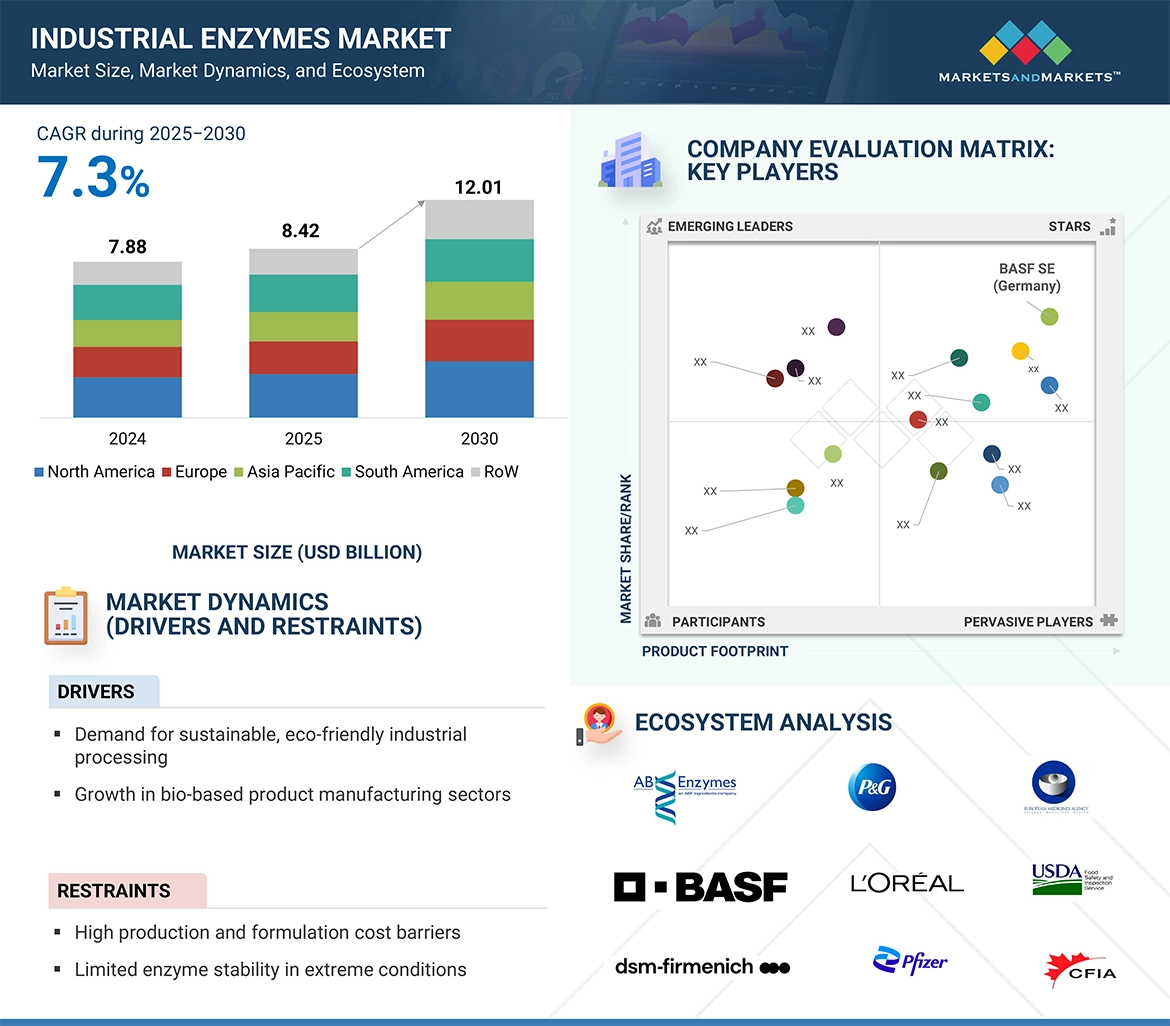
Industrial Enzymes Market

Key industries—including food & beverages, textiles, bioethanol, detergents, and wastewater treatment—are integrating enzyme technologies to enhance product yield, quality, and compliance with tightening regulations. Continued advancements in enzyme engineering, fermentation processes, and immobilization techniques are further expanding their industrial applicability, particularly in harsh operating environments.

The transition toward circular economy models and bio-based production, supported by proactive government initiatives across Europe, India, and Southeast Asia, is also accelerating the adoption of enzyme technologies. As clean manufacturing becomes a global priority, industrial enzymes are poised to play a critical role in next-generation industrial value chains.

Download PDF Brochure: https://www.marketsandmarkets.com/pdfdownloadNew.asp?id=237327836

Microbial Enzymes Lead the Market by Source

Microorganism-derived enzymes hold the largest market share, owing to their high efficiency, scalability, and adaptability. Enzymes sourced from bacteria (e.g., Bacillus) and fungi (e.g., Aspergillus) operate effectively across wide pH and temperature ranges, making them ideal for diverse applications.

Microbial fermentation enables cost-effective, large-scale enzyme production with consistent quality. Additionally, genetic modification allows tailored solutions with enhanced specificity and stability. Unlike enzymes from plant or animal origins, microbial enzymes face fewer supply chain disruptions and are easier to standardize—making them the preferred source for industrial use.

Wastewater Treatment: Fastest-Growing Application Segment

The wastewater treatment segment is emerging as the fastest-growing application, driven by increasing environmental regulations and the urgent need for sustainable water management. Enzymes offer a biodegradable and efficient solution for breaking down complex organic pollutants in municipal and industrial effluents—reducing the reliance on chemicals, minimizing sludge generation, and improving treatment performance.

With urbanization and industrialization increasing wastewater volume and complexity, enzyme-based treatment solutions offer targeted action, regulatory compliance, and operational efficiency. Breakthroughs in enzyme design have also enabled performance in challenging environmental conditions, broadening their applicability.

A notable advancement came in May 2025 from India’s NIT Rourkela, where researchers developed a solar-powered wastewater treatment system using reusable spherical concrete beads as photocatalysts. This innovation achieved 82% COD reduction and retained 90% efficiency across 15 cycles, offering a sustainable, low-cost solution for resource-limited settings. Published in the Journal of Water Processing Engineering, the innovation is patent-pending.

Request Sample Pages: https://www.marketsandmarkets.com/requestsampleNew.asp?id=237327836

Asia Pacific: Dominating the Regional Landscape

Asia Pacific currently leads the global industrial enzymes market, fueled by rapid industrialization, expanding manufacturing capabilities, and strong regulatory support for green technologies. Major economies like China, India, and Southeast Asia are witnessing significant enzyme adoption in food processing, textiles, biofuels, and water treatment.

Rising demand for processed foods and heightened environmental consciousness are accelerating this trend. Policies such as India’s BioE3 initiative (launched August 2024) are boosting domestic enzyme production and innovation. The region’s competitive advantages—such as low-cost inputs, skilled workforce, and pro-business environments—have attracted significant investments in enzyme R&D and manufacturing infrastructure.

In March 2024, Novus International, Inc. acquired BioResource International, Inc. (US)—strengthening its portfolio of enzyme products, expanding its innovation pipeline, and enhancing its position in the animal feed additives space.

Leading Industrial Enzymes Companies:

The report profiles key players such as BASF SE (Germany), International Flavors & Fragrances Inc. (US), DSM-Firmenich (Switzerland), Kerry Group plc. (Ireland), Dyadic International Inc (US), Advanced Enzyme Technologies (India), Aumgene Biosciences (India), Amano Enzyme Inc (Japan), Associated British Foods plc (England), Novozymes A/S (Denmark), F. Hoffmann-La Roche Ltd (Switzerland), Codexis, Inc. (US), Sanofi (France), Merck KGaA (Germany), and Adisseo (China).

Industrial Enzymes Market Share, Trends and Forecast to 2028

Industrial Enzymes Market forecast

Industrial enzymes are proteins that are used in various industrial processes to catalyze chemical reactions. These enzymes are derived from microorganisms such as bacteria, fungi, and yeast, as well as from plants and animals. They are highly specific catalysts, meaning they accelerate specific chemical reactions without being consumed in the process. The global industrial enzymes market will grow from USD 7.4 billion in 2023 to USD 10.2 billion by 2028, growing at a CAGR of 6.6% during the forecast period.

Industrial enzymes find applications in a wide range of industries including food and beverage, agriculture, biofuel production, textiles, pulp and paper, pharmaceuticals, and detergents.

Inquiry before buying: https://www.marketsandmarkets.com/Enquiry_Before_BuyingNew.asp?id=237327836

Some common types of industrial enzymes include:

  • Amylases: These enzymes break down starch into simpler sugars such as glucose and maltose. They are used in industries such as baking, brewing, and starch processing.
  • Proteases: Proteases catalyze the breakdown of proteins into smaller peptides and amino acids. They are utilized in industries such as food processing, detergents, and pharmaceuticals.
  • Lipases: Lipases catalyze the hydrolysis of fats and oils into fatty acids and glycerol. They find applications in industries such as food processing, biodiesel production, and detergent manufacturing.
  • Cellulases: Cellulases break down cellulose, a complex carbohydrate found in plant cell walls, into simpler sugars. They are used in industries such as biofuel production, textile processing, and pulp and paper manufacturing.
  • Pectinases: Pectinases catalyze the breakdown of pectin, a complex polysaccharide found in plant cell walls, into simpler sugars. They are used in industries such as fruit juice extraction and wine making.
  • Xylanases: Xylanases hydrolyze xylan, a component of hemicellulose found in plant cell walls, into xylose and other sugars. They find applications in industries such as biofuel production, pulp and paper processing, and animal feed.

Industrial Enzymes Market trends

  • Increasing demand for sustainable and eco-friendly solutions: With growing environmental concerns, industries are increasingly shifting towards sustainable manufacturing processes. Industrial enzymes offer a green alternative by enabling efficient and environmentally friendly production methods. This trend is driving the adoption of enzymes across various industries such as food and beverage, textiles, pulp and paper, and biofuels.
  • Rising application in food and beverage industry: Enzymes play a crucial role in the food and beverage industry, where they are used for various purposes including food processing, flavor enhancement, and shelf-life extension. As consumers become more health-conscious and demand natural and clean label products, the use of enzymes in food processing is expected to increase further. Moreover, enzymes offer benefits such as improved texture, flavor, and nutritional profile of food products, driving their widespread adoption in the food industry.
  • Advancements in enzyme engineering and biotechnology: Continuous advancements in enzyme engineering and biotechnology are expanding the functionalities and applications of industrial enzymes. Researchers are developing novel enzymes with enhanced stability, activity, and specificity, allowing for their use in a broader range of industrial processes. These advancements are fueling innovation in enzyme-based solutions and driving market growth.
  • Growing focus on biofuel production: With increasing concerns about climate change and depletion of fossil fuel resources, there is a growing emphasis on biofuel production as a renewable energy source. Enzymes such as cellulases and xylanases play a crucial role in the conversion of biomass into biofuels such as ethanol and biodiesel. As governments worldwide implement policies to promote the use of biofuels, the demand for enzymes in biofuel production is expected to rise significantly.
  • Expansion in emerging markets: Emerging economies in regions such as Asia-Pacific, Latin America, and the Middle East are witnessing rapid industrialization and urbanization, driving demand for industrial enzymes. Increasing investments in biotechnology research and development, coupled with supportive government policies, are creating favorable conditions for market growth in these regions. Moreover, rising disposable incomes and changing consumer preferences towards processed and convenience foods are further driving the demand for enzymes in these markets.

Industrial Enzymes Market share

The key players in the industrial enzymes market include BASF (Germany), Novozymes (Denmark), DuPont (US), DSM (Netherlands), Associated British Foods plc (UK), Kerry Group plc. (Ireland), Advanced Enzyme Technologies. (India), Chr. Hansen Holding A/S (Denmark), Amano Enzyme Inc. (Japan), Aumgene Biosciences Pvt. Ltd. (India).

Speak to Analyst: https://www.marketsandmarkets.com/speaktoanalystNew.asp?id=237327836