Exploring the Future: Trends and Innovations in the Hydrocolloids Market

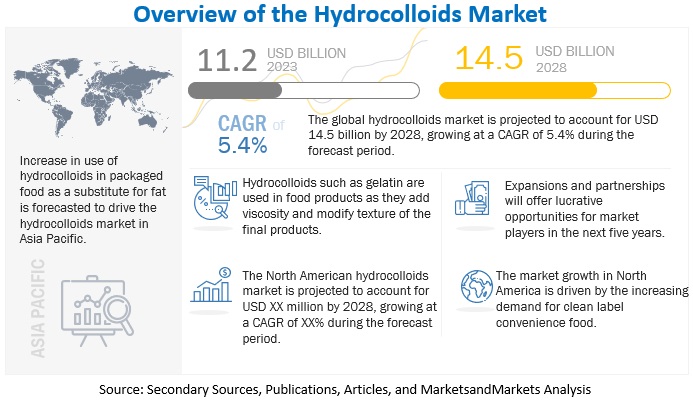
The global hydrocolloids market is estimated to be valued at USD 11.2 billion in 2023 and is projected to reach USD 14.5 billion by 2028, at a CAGR of 5.4% during the forecast period. The exponential growth in the natural and clean-label food consumption across the food and beverage industry due to its growing awareness has influenced the use of hydrocolloids. Moreover, this has led to an increase in dependence on natural fibers and gums for functional properties, stability, safety, and quality of food products. According to the American Oil chemist society Journal of 2015, hydrocolloids, apart from imparting textural properties, also enhance the nutritional properties of the food as they contain nearly 60%-90% of dietary fibers.

Download PDF brochure: https://www.marketsandmarkets.com/pdfdownloadNew.asp?id=1231

In terms of type, pectin is estimated to be the fastest type segment during the forecast period

Pectin is an important polysaccharide with applications in food, pharmaceuticals, and many other industries. It is used as an emulsifier, gelling agent, thickener, stabilizer, and fat or sugar replacer in a low-calorie food. Pectin and pectin-derived oligosaccharides can also be used as important ingredients in functional food. Its importance in the food sector lies in its ability to form a gel in the presence of Ca2+ ions or a solute at low pH.

The seaweed segment by source in the hydrocolloids market is projected to grow at the highest CAGR during the forecasted period

Seaweed-derived hydrocolloids mainly include alginate, carrageenan, and agar, which are important parts of the food ingredient industry. The three types of hydrocolloids are natural hydrophilic polymers existing in the cell walls and extracellular matrixes of brown and red seaweeds that can be extracted through a series of chemical and physical processes. Owing to their excellent thickening, gelling, film-forming, and other novel properties, alginate, carrageenan, and agar are widely used in the functional food industry.  Seaweed hydrocolloids find application as thickeners, stabilizers, coagulants, and salves (in the wound and burn dressings) and they are used as materials to produce bio-medical impressions in the food, pharmaceutical, and biotechnology industries.

The Cosmetics & personal care products segment is projected to be the second-largest market in the forecasted period

Recently, hydrocolloids have found a fit in the personal care industry, often replacing synthetic chemicals with similar properties. Driven by consumers’ thirst for “all-natural” products, many manufacturers are trying to leverage the long history of hydrocolloids in the food industry for personal care applications. Therefore, with wide consumer interest in natural cosmetics, the number and demand for natural texturizers have grown strongly in recent years.

Speak to Analyst: https://www.marketsandmarkets.com/speaktoanalystNew.asp?id=1231

Hydrocolloids Market Size, Share & Growth Report, 2028

The global hydrocolloids market size was estimated at USD 11.2 billion in 2023 and is expected to expand at a compound annual growth rate (CAGR) of 5.4% from 2023 to 2028. The exponential growth in the natural and clean-label food consumption across the food and beverage industry due to its growing awareness has influenced the use of hydrocolloids.

Download PDF brochure: https://www.marketsandmarkets.com/pdfdownloadNew.asp?id=1231

Here are some factors that contribute to the demand for hydrocolloids market:

  • Texture enhancement: Hydrocolloids provide texture and mouthfeel improvement to food products, making them more appealing to consumers. They can be used to create smooth and creamy textures in dairy products, improve the structure of baked goods, and add thickness to sauces and dressings.
  • Stabilization and emulsification: Hydrocolloids act as stabilizers and emulsifiers, helping to prevent separation and improve the stability of food formulations. They are commonly used in beverages, dressings, and sauces to maintain a consistent texture and appearance.
  • Increased shelf life: Hydrocolloids help extend the shelf life of food products by controlling water migration and preventing spoilage. They can bind water, reducing water activity and inhibiting microbial growth, thus enhancing the product’s longevity.
  • Clean label and natural formulations: With the growing consumer preference for clean label and natural ingredients, hydrocolloids offer a valuable solution. They can be derived from natural sources and provide functionality like synthetic additives, allowing food manufacturers to meet consumer demands for more natural and transparent product formulations.
  • Dietary and health benefits: Certain hydrocolloids, such as dietary fibers, offer health benefits like improved digestion and gut health. As consumers become more health-conscious, the demand for products incorporating these hydrocolloids is on the rise.
  • Expansion in various industries: Hydrocolloids find applications not only in the food industry but also in pharmaceuticals, cosmetics, and other sectors. The versatility of hydrocolloids makes them a sought-after ingredient in a wide range of products, further driving market growth.

Inquiry before buying: https://www.marketsandmarkets.com/Enquiry_Before_BuyingNew.asp?id=1231

Regional Insights of Hydrocolloids Market Report

North America is projected to gain the largest market share in the global hydrocolloids market. Given the nation’s food habits and eating habits, there is a special demand for the ingredient that reduces oil and fat in US. It serves as a barrier for the oil and fat found in the widely consumed breaded and fried cuisine in the country. It is possible to substitute calorie-dense fat and oil with what is essentially structured water by employing hydrocolloids. Customers prefer foods that are low in oil and fat, which is attainable with the right use of hydrocolloids. The hydrocolloids market in the nation is anticipated to grow further because of the huge rise in the number of health-conscious consumers.

Hydrocolloids Market Size, Share & Growth Report, 2028

The Hydrocolloids Market Size highlights the market’s growth potential, projecting a value of around USD 14.5 billion by 2028, up from USD 11.2 billion in 2023. This trajectory suggests a promising compound annual growth rate (CAGR) of 5.4% from 2023 to 2028.

Hydrocolloids Market Report Summary

The hydrocolloids market report has been witnessing steady growth owing to their wide-ranging applications across various industries. Hydrocolloids are substances that form gel-like textures when mixed with water and are extensively used in food, pharmaceuticals, cosmetics, and other sectors.

Key Findings:

  • Growing Demand in Food Industry: The food industry is the primary driver of the hydrocolloids market, with increasing demand for hydrocolloids in food processing, bakery, confectionery, and dairy products.
  • Functional Properties: Hydrocolloids are valued for their functional properties such as thickening, gelling, stabilizing, and emulsifying, which enhance the texture and quality of food products.
  • Health and Wellness Trends: Consumer preferences for natural and organic ingredients have led to the incorporation of hydrocolloids in healthier food formulations, driving market growth.
  • Pharmaceutical Applications: Hydrocolloids find applications in the pharmaceutical industry for drug delivery systems, wound care products, and as excipients in tablet formulations.

Download PDF brochure: https://www.marketsandmarkets.com/pdfdownloadNew.asp?id=1231

Hydrocolloids Market Set to Boom in the Near Future, According to Market Research Intellect Analysis

The report offers a comprehensive analysis of the current state of the Plant Source Hydrocolloids Market, with a focus on key metrics such as CAGR, gross margin, revenue, price, production growth rate, volume, value, market share, and year-over-year growth. This analysis is conducted using the latest primary and secondary research methodologies, ensuring accuracy and reliability. Regional markets, including North America, Europe, India, China, Japan, and MEA, are examined in detail. Leading company profiles are provided, taking into account factors such as markets served, production, revenue, market share, recent innovations, and gross profit margins. Additionally, a specialized market dynamics section offers an in-depth examination of the market’s drivers, constraints, opportunities, influencers, challenges, and trends.

Driving Factors of Hydrocolloids Market

  • Versatile Applications: Hydrocolloids find extensive use across multiple industries such as food and beverage, pharmaceuticals, cosmetics, and personal care due to their diverse functionalities including thickening, gelling, stabilizing, and emulsifying. This versatility drives demand from various sectors, contributing to market growth.
  • Consumer Demand for Natural Products: With increasing awareness about health and wellness, consumers are increasingly seeking natural and clean label products. Hydrocolloids derived from natural sources such as plants are preferred over synthetic alternatives, driving market demand as manufacturers strive to meet consumer preferences.
  • Functional Properties: Hydrocolloids offer unique functional properties that enhance the texture, appearance, and stability of products. They act as effective thickeners, stabilizers, and gelling agents in food products, pharmaceutical formulations, and personal care items, thereby driving their widespread adoption.
  • Technological Advancements: Ongoing research and development efforts in hydrocolloid processing techniques and formulations contribute to the expansion of the market. Innovations in manufacturing processes and product formulations lead to improved functionalities, increased efficiency, and expanded applications, thereby driving market growth.
  • Health and Wellness Trends: Hydrocolloids are increasingly being incorporated into health-conscious products due to their ability to improve product texture and quality without compromising nutritional value. This aligns with the growing consumer focus on healthier food choices, driving demand for hydrocolloid-based products.
  • Globalization and Urbanization: Rapid urbanization and globalization have led to changing dietary habits and increased consumption of processed and convenience foods. Hydrocolloids play a crucial role in enhancing the quality and stability of these products, driving their demand in both developed and emerging markets.
  • Regulatory Support: Favorable regulatory frameworks and approvals for the use of hydrocolloids in various industries bolster market growth. Clear guidelines ensure product safety and quality, providing manufacturers with confidence in incorporating hydrocolloids into their formulations.

Key Factors Driving Hydrocolloids Market Growth

Following are some key factors driving hydrocolloids market growth:

  • Increasing Applications: Hydrocolloids are witnessing rising demand due to their versatile applications in food processing, pharmaceuticals, cosmetics, and other sectors. Their ability to enhance texture, stability, and functionality in products has led to widespread adoption.
  • Consumer Preferences: Changing consumer preferences towards natural and clean label products have fueled the demand for hydrocolloids derived from plant-based sources. This shift aligns with the growing focus on sustainability and health-conscious choices among consumers.
  • Functional Properties: Hydrocolloids offer a range of functional properties such as thickening, gelling, stabilizing, and emulsifying, which are essential for product formulation and quality enhancement. Their effectiveness in improving the sensory attributes of food and personal care products further contributes to market growth.
  • Technological Advancements: Ongoing research and development efforts in the hydrocolloids sector are driving technological advancements aimed at enhancing product performance, stability, and application versatility. Innovative processing techniques and formulations are expected to expand the market opportunities for hydrocolloids.
  • Market Expansion in Emerging Regions: The hydrocolloids market is witnessing significant growth in emerging regions, particularly in Asia-Pacific, driven by rapid industrialization, urbanization, and changing dietary habits. This region presents lucrative opportunities for market players to expand their presence and tap into new consumer markets.

Speak to Analyst: https://www.marketsandmarkets.com/speaktoanalystNew.asp?id=1231

Regional Analysis of Hydrocolloids Market

North America

North America holds a significant share of the hydrocolloids market, driven by the widespread adoption of hydrocolloids in the food and beverage industry.

The United States is a major contributor to market growth, with a strong presence of food processing companies and pharmaceutical manufacturers incorporating hydrocolloids into their products.

Growing consumer demand for clean label and natural ingredients is propelling the market for plant-based hydrocolloids such as guar gum, xanthan gum, and carrageenan.

Europe

Europe is another prominent market for hydrocolloids, characterized by a mature food processing industry and stringent regulations governing food additives.

Countries like Germany, France, and the UK are key consumers of hydrocolloids, driven by the demand for convenience foods, bakery products, and pharmaceutical formulations.

The shift towards sustainable and environmentally friendly ingredients is driving the adoption of natural hydrocolloids in the region.

Asia-Pacific

The Asia-Pacific region is witnessing rapid growth in the hydrocolloids market, fueled by increasing industrialization, urbanization, and changing dietary habits.

Countries like China, India, Japan, and South Korea are major contributors to market expansion, with a growing demand for hydrocolloids in food processing, pharmaceuticals, and personal care products.

Rising disposable incomes and a burgeoning middle-class population are driving consumption of processed and convenience foods, boosting the demand for hydrocolloids in the region.

Browse some food and beverage industry market reports:

Food Anti-Caking Agents Market
The Rising Tide: Exploring the Growth Trajectory of the Hydrocolloids Market

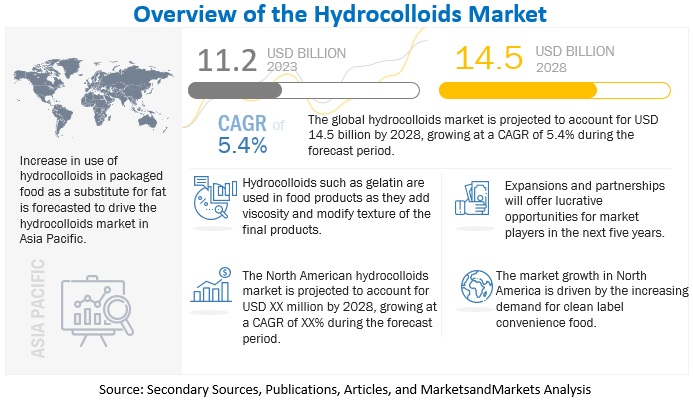
The hydrocolloids market size is poised for substantial growth, with a projected Compound Annual Growth Rate (CAGR) of 5.4% between 2023 and 2028. The market is expected to reach a value of $14.5 billion by 2028, up from a projected $11.2 billion in 2023. Hydrocolloids, recognized for their multifunctionality, find extensive use in the food sector as additives serving various roles such as gelling agent, thickener, emulsifier, fat substitute, stabilizer, flocculating agent, clarifying agent, whipping agent, and clouding agent.

Download PDF brochure: https://www.marketsandmarkets.com/pdfdownloadNew.asp?id=1231

Drivers:

The multifunctionality of hydrocolloids positions them as versatile additives with a broad spectrum of applications. In food formulations, hydrocolloids are commonly used to enhance quality and extend shelf life. These ingredients play a crucial role in diverse food products, including soups, salad dressings, gravies, sauces, jellies, and more. Moreover, hydrocolloids contribute to the improvement of food texture and moisture retention in the baking sector, thereby enhancing overall product quality during storage.

Opportunities:

Emerging markets in Asia Pacific and Africa present significant opportunities for the hydrocolloids market. The escalating global population is placing increased pressure on the production, exploitation, and preservation of resources. Hydrocolloids, produced on a large scale in these regions, can aid small and medium-scale food and beverage manufacturers in integrating clean label ingredients. This, in turn, is expected to contribute to the expansion of the hydrocolloids market.

Type Insights:

The gelatin segment is projected to dominate the hydrocolloids market, although there is a notable shift towards plant-based hydrocolloids due to growing health and environmental awareness. Factors such as the rise in the overweight and obese population globally are anticipated to significantly impact the demand for hydrocolloids in food products that offer lower fat, sugar, and salt content without compromising texture, flavor, or aroma.

Request Sample Pages: https://www.marketsandmarkets.com/requestsampleNew.asp?id=1231

Application Insights:

In terms of applications, the food and beverages segment is forecasted to account for the largest share in the market. Hydrocolloids play a vital role in enhancing the cooking yield, texture, and slice qualities of meat and poultry products. Various hydrocolloids, such as carrageenan, agar, xanthan gum, gelatin, alginate, pectin, and locust bean gum, contribute to different aspects, including moisture preservation, fat content reduction, and texture improvement in meat products.

Regional Insights:

North America is anticipated to gain the largest hydrocolloids market share. The demand for hydrocolloids in the region is driven by changing food habits and a growing preference for ingredients that reduce oil and fat. Hydrocolloids serve as effective barriers for oil and fat in popular American breaded and fried cuisine. The rising number of health-conscious consumers further propels the growth of the hydrocolloids industry in North America.