Hydrocolloids in Food and Beverage Industry: A Market Analysis

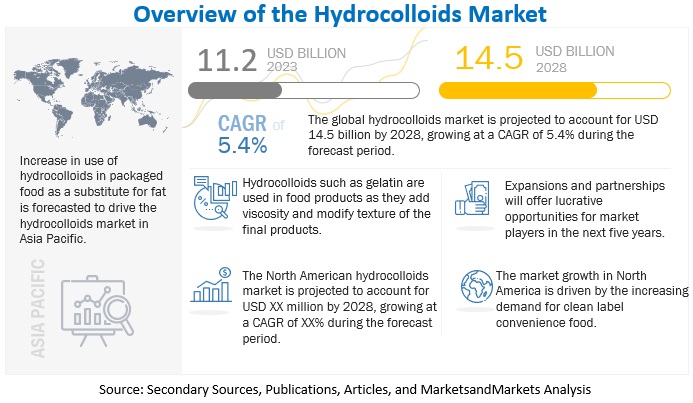
The global hydrocolloids market size was valued at USD 11.2 billion in 2023 and is poised to reach USD 14.5 billion by 2028, growing at a CAGR of 5.4% from 2023–2028. One of the most often utilized additives in the food sector is hydrocolloid. In addition to serving as gelling agent, thickener, emulsifier, fat substitute, and stabilizer, it is also used as flocculating agent, clarifying agent, whipping agent, and clouding agent. Moreover, hydrocolloids are used to create edible films, encapsulate flavors, and inhibit crystallization. Also, it is now known that hydrocolloids have a wide range of functions in the field of health, including the provision of dietary fiber with less calories.

Download PDF brochure: https://www.marketsandmarkets.com/pdfdownloadNew.asp?id=1231

North America is estimated to be the fastest region during the forecast period

The North American hydrocolloids market is also driven by its application in premium food products. The leading manufacturers of hydrocolloids in North America include Ashland Inc. (US), CP Kelco (US), Cargill, Incorporated (US), Ingredion Incorporated (US), and Darling Ingredients Inc. (US). The North American market is completely driven by the US. The US has a large market for bakery, confectionery, convenience food, and packaged food products; hence, it constitutes a major share in the market. Consumers in the US are calorie-conscious due to which low-calorie and low-fat food products are popular in the country. The increasing prevalence of obesity and cardiac diseases has led consumers to demand natural and low-calorie food products. Food manufacturers are therefore concentrating on the application of natural hydrocolloids and their function as fat replacers.

Key players in this market include International Flavors & Fragrances Inc. (US), Ingredion (US), Cargill, Incorporated (US), Kerry Group plc (Ireland), Associated Archer Daniels Midland Company (US), Palsgaard A/S (Denmark), Darling Ingredients Inc. (US), DSM (Netherlands), Ashland (US), Tate & Lyle (UK), CP Kelco U.S., Inc. (US), Nexira (France), Deosen Biochemical (Ordos) Ltd. (China), Fufeng Group (China), and BASF SE (Germany).

Stabilizers, by function, is estimated to be the fastest-growing function of hydrocolloids during the forecast period

Stabilizers add viscosity to enhance overall flavor and give body to beverages while also preventing sedimentation and keeping ingredients suspended within the finished product. Stabilizers are additives used to help maintain emulsions or prevent degeneration in beverages. The most common stabilizers are hydrocolloids (such as xanthan, gum Arabic, and gum acacia), modified starches, pectin, carrageenan, casein, and inulin. The purpose of stabilizers is to add viscosity to enhance flavor and give body to a beverage. They also maintain emulsification, which prevents sedimentation by keeping additional ingredients suspended in the product.

Speak to Analyst: https://www.marketsandmarkets.com/speaktoanalystNew.asp?id=1231

The Cosmetics & personal care products segment is projected to be the second-largest market in the forecasted period

Recently, hydrocolloids have found a fit in the personal care industry, often replacing synthetic chemicals with similar properties. Driven by consumers’ thirst for “all-natural” products, many manufacturers are trying to leverage the long history of hydrocolloids in the food industry for personal care applications. Therefore, with wide consumer interest in natural cosmetics, the number and demand for natural texturizers have grown strongly in recent years.
Exploring the Future: Trends and Innovations in the Hydrocolloids Market

The global hydrocolloids market is estimated to be valued at USD 11.2 billion in 2023 and is projected to reach USD 14.5 billion by 2028, at a CAGR of 5.4% during the forecast period. The exponential growth in the natural and clean-label food consumption across the food and beverage industry due to its growing awareness has influenced the use of hydrocolloids. Moreover, this has led to an increase in dependence on natural fibers and gums for functional properties, stability, safety, and quality of food products. According to the American Oil chemist society Journal of 2015, hydrocolloids, apart from imparting textural properties, also enhance the nutritional properties of the food as they contain nearly 60%-90% of dietary fibers.

Download PDF brochure: https://www.marketsandmarkets.com/pdfdownloadNew.asp?id=1231

In terms of type, pectin is estimated to be the fastest type segment during the forecast period

Pectin is an important polysaccharide with applications in food, pharmaceuticals, and many other industries. It is used as an emulsifier, gelling agent, thickener, stabilizer, and fat or sugar replacer in a low-calorie food. Pectin and pectin-derived oligosaccharides can also be used as important ingredients in functional food. Its importance in the food sector lies in its ability to form a gel in the presence of Ca2+ ions or a solute at low pH.

The seaweed segment by source in the hydrocolloids market is projected to grow at the highest CAGR during the forecasted period

Seaweed-derived hydrocolloids mainly include alginate, carrageenan, and agar, which are important parts of the food ingredient industry. The three types of hydrocolloids are natural hydrophilic polymers existing in the cell walls and extracellular matrixes of brown and red seaweeds that can be extracted through a series of chemical and physical processes. Owing to their excellent thickening, gelling, film-forming, and other novel properties, alginate, carrageenan, and agar are widely used in the functional food industry.  Seaweed hydrocolloids find application as thickeners, stabilizers, coagulants, and salves (in the wound and burn dressings) and they are used as materials to produce bio-medical impressions in the food, pharmaceutical, and biotechnology industries.

The Cosmetics & personal care products segment is projected to be the second-largest market in the forecasted period

Recently, hydrocolloids have found a fit in the personal care industry, often replacing synthetic chemicals with similar properties. Driven by consumers’ thirst for “all-natural” products, many manufacturers are trying to leverage the long history of hydrocolloids in the food industry for personal care applications. Therefore, with wide consumer interest in natural cosmetics, the number and demand for natural texturizers have grown strongly in recent years.

Speak to Analyst: https://www.marketsandmarkets.com/speaktoanalystNew.asp?id=1231

Beyond the Gel: Unveiling the Versatility of Hydrocolloids

The hydrocolloids market refers to the industry involved in the production and distribution of hydrocolloids, which are a group of substances that can form a gel-like structure when combined with water. These compounds are widely used in various industries, including food and beverages, pharmaceuticals, cosmetics, and more.

Download PDF brochure: https://www.marketsandmarkets.com/pdfdownloadNew.asp?id=1231

Hydrocolloids play a crucial role in food products, where they are used as thickening agents, stabilizers, emulsifiers, and gelling agents. Common examples of hydrocolloids include carrageenan, guar gum, xanthan gum, pectin, and agar. These ingredients contribute to the texture, viscosity, and overall quality of many processed foods.

The food industry represents a significant portion of the hydrocolloids market, driven by the increasing demand for processed and convenience foods. Hydrocolloids are essential in enhancing the sensory attributes of food products and improving their shelf life. Additionally, they are employed in the pharmaceutical industry for various purposes, such as the formulation of drug delivery systems.

The cosmetics and personal care industry also utilize hydrocolloids in the production of creams, lotions, and other beauty products. Their ability to modify the rheological properties of formulations makes them valuable in achieving the desired texture and stability in cosmetic applications.

The market for hydrocolloids is influenced by factors such as consumer preferences for convenience foods, the growing awareness of health and wellness, and advancements in food technology. As the demand for innovative and functional ingredients continues to rise, the hydrocolloids market is expected to experience sustained growth.

Request Sample Pages: https://www.marketsandmarkets.com/requestsampleNew.asp?id=1231

Manufacturers in the hydrocolloids industry focus on research and development to discover new applications and improve the functionality of existing hydrocolloid products. This constant innovation contributes to the expansion of the market and provides opportunities for businesses to meet evolving consumer demands.

Overall, the hydrocolloids market plays a vital role in various industries, offering versatile solutions for product development and formulation across food, pharmaceuticals, cosmetics, and other sectors. The ongoing evolution of consumer preferences and industry regulations will likely shape the trajectory of this market in the coming years.

Hydrocolloids Market – Analysis with Ongoing Trends & Market Revenue

The market for hydrocolloids is estimated at USD 8.8 billion in 2018 and is projected to grow at a CAGR of 5.3% from 2018 to 2023, to reach USD 11.4 billion by 2023. The growth of the hydrocolloids market is driven by the rising demand for convenience foods in the food industry. The key market drivers are the R&D activities and innovation, consumer preference for functional dairy products, and multifunctionality of hydrocolloids in food & beverage products.

Drivers

  • Rise in Consumption of Premium Food & Beverage Products
  • Multi-Functionality of Hydrocolloids Leads to Their Wide Range of Applications
  • Increase in Health-Consciousness Among Consumers Drives the Natural Hydrocolloids Market            

Restraints

  • Stringent International Quality Standards and Regulations                     
  • Shortage of Resources has Created A Demand-Supply Imbalance

Opportunities

  • The Emerging Markets Illustrate Great Potential for Hydrocolloids
  • Increase in Investments in Research & Development

Challenges

  • Fluctuations in Prices of Raw Materials
  • Unclear Labeling Leading to Ambiguity and Uncertainty

Request for Sample Report Pages: https://www.marketsandmarkets.com/requestsampleNew.asp?id=1231

The food & beverage segment, by application, is projected to be the largest revenue contributor in the hydrocolloids market during the forecast period.

The food & beverage segment is accounted to hold the largest share in the hydrocolloids market in 2018. Hydrocolloids are widely used in food products such as bakery, confectionery, meat & poultry, beverages, and dairy & frozen products. The growth of the hydrocolloids market is driven by the rising demand for convenience foods from the food industry.

The demand for thickeners segment, by function, is estimated to rise and dominate the hydrocolloids market during the forecast period.

In terms of function, thickeners and stabilizers were the most widely preferred functions for hydrocolloids. The market was dominated by the thickening segment and is used to maintain viscosity in the presence of electrolytes, high temperature, and wide pH ranges in food products such as soups & gravies, ketchup, instant beverages, desserts, toppings, and fillings. This thickening segment accounted for 40% of the market in 2017.

North America is projected to account for the largest market size during the forecast period.

North America is a dominant region in the global hydrocolloids market. Factors influencing its market dominance include the high demand for functional dairy products, convenience foods, higher per capita consumption of baked goods, and presence of major players. 

This report includes a study of marketing and development strategies along with the product portfolios of leading companies in the hydrocolloids market. It includes profiles of leading companies such as Ingredion (US), Cargill (US), DowDuPont (US), Darling Ingredients (US), ADM (US), and Kerry (Ireland).