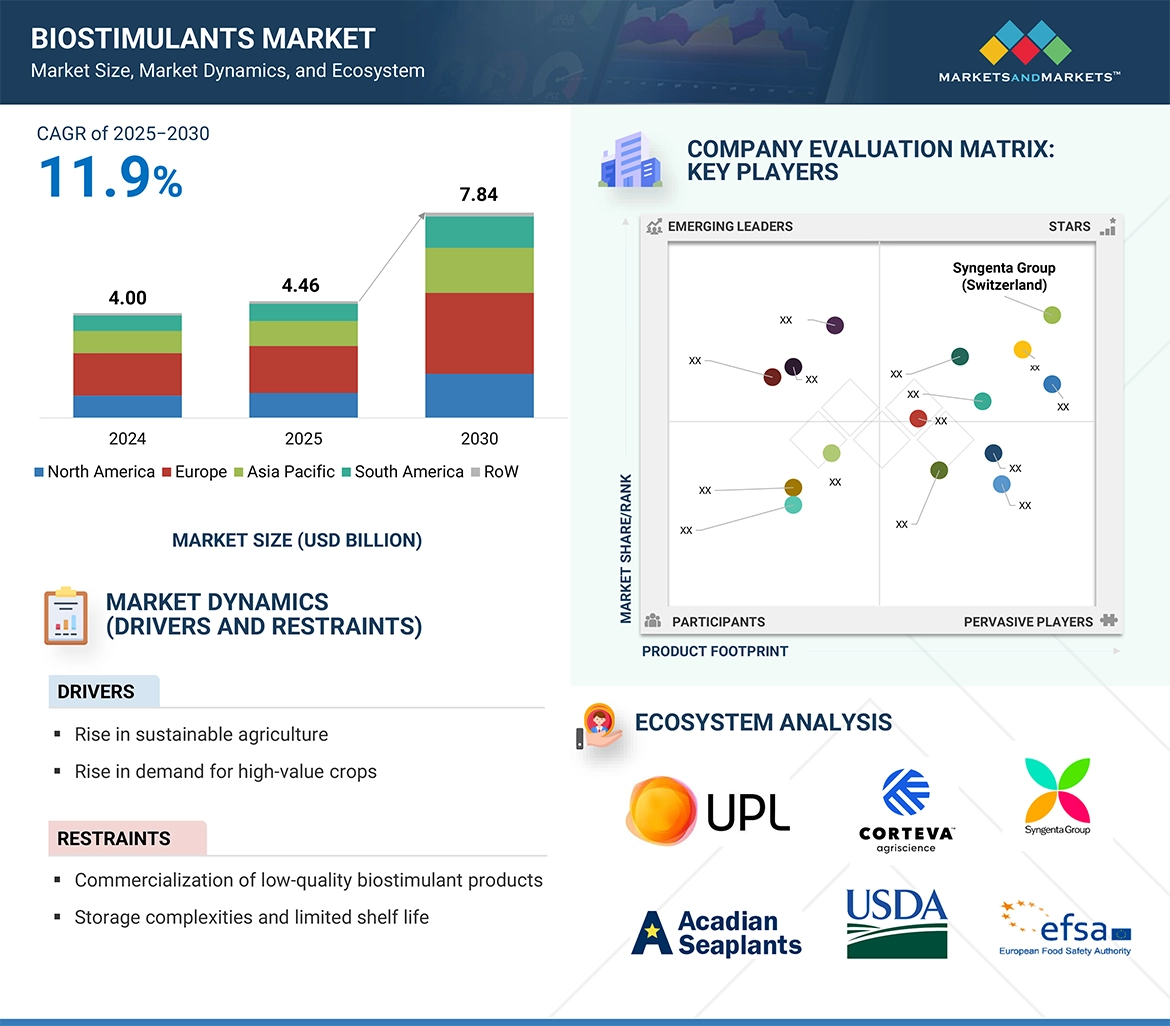
The global biostimulants market is projected to grow from USD 4.97 billion in 2026 to USD 8.77 billion by 2031, registering a compound annual growth rate (CAGR) of 12.0% during the forecast period. The market is experiencing robust expansion as farmers, agribusinesses, and commercial growers increasingly adopt biostimulants to improve crop productivity while promoting environmentally sustainable agricultural practices.
The growing emphasis on improving nutrient efficiency, enhancing plant resilience to environmental stresses, and maintaining long-term soil health has significantly accelerated the adoption of biostimulants worldwide. Europe and North America continue to lead market adoption, particularly in cereal, horticultural, and high-value crop production, where biostimulants play a critical role in improving crop performance and yield stability.
The rising demand for microbial-based products, seaweed extracts, amino acid formulations, and other natural biostimulant solutions is further strengthening market growth. In addition, advancements in precision agriculture, digital farming technologies, agritech platforms, and expanding distribution networks are making these products more accessible to both commercial and smallholder farmers across global agricultural markets.
Download PDF Brochure: https://www.marketsandmarkets.com/pdfdownloadNew.asp?id=1081
Liquid Form Segment Dominates the Market
Among various product forms, the liquid segment continues to account for a significant share of the global biostimulants market. Liquid biostimulants are widely preferred due to their ease of application, uniform crop coverage, and compatibility with foliar spraying, fertigation, and seed treatment systems.
These formulations—including microbial suspensions, seaweed extracts, amino acid blends, and nutrient-based solutions—offer rapid absorption, efficient nutrient delivery, and enhanced protection against abiotic stresses. Their ability to integrate seamlessly with existing crop nutrition and crop protection programs has further increased their popularity among growers seeking convenient, ready-to-use solutions for improving crop performance.
Cereals & Grains Segment Registers Strong Growth
Based on crop type, the cereals & grains segment is expected to witness substantial growth throughout the forecast period. Extensive cultivation of staple crops such as wheat, rice, and maize continues to drive demand for biostimulants that enhance nutrient uptake, stimulate root development, and improve tolerance to drought, heat, and salinity.
Growing global demand for food grains, supportive government initiatives promoting sustainable agriculture, and increasing farmer awareness regarding yield optimization are contributing significantly to segment growth. The widespread application of microbial, seaweed-based, and amino acid biostimulants is helping improve crop productivity while supporting sustainable farming objectives.
Request Sample Pages: https://www.marketsandmarkets.com/requestsampleNew.asp?id=1081
North America Holds a Significant Market Share
North America represents a significant share of the global biostimulants market, supported by advanced farming practices, increasing investment in biological crop inputs, and widespread adoption of sustainable agriculture technologies.
Farmers across the United States and Canada are increasingly utilizing biostimulants to improve nutrient use efficiency, strengthen plant resilience under environmental stress, and preserve soil fertility while reducing dependence on conventional agrochemicals. Favorable regulatory developments, continued research and innovation, and the expansion of high-value crop cultivation—including fruits, vegetables, and specialty crops—are expected to further support regional market growth.
Leading Biostimulants Companies:
Major companies operating in the global biostimulants market include UPL Limited (India), FMC Corporation (US), Corteva Agriscience (US), Sumitomo Chemical Co., Ltd. (Japan), Nufarm Limited (Australia), Novonesis (Denmark), BASF SE (Germany), Bayer AG (Germany), PI Industries Ltd. (India), T. Stanes & Company Limited (India), J.M. Huber Corporation (US), Gowan Company (US), Koppert Biological Systems (Netherlands), Acadian Seaplants Limited (Canada), Qingdao Seawin Biotech Group Co., Ltd. (China), OMEX Agriculture (UK), Seipasa S.A. (Spain), Aminocore (South Africa), and Cascadia Seaweed Corp. (Canada).