
Global Agricultural Biologicals Market: Technological Innovations and Future Forecasts

marketsandmarkets logo

The global agricultural biologicals market is valued at USD 18.44 billion in 2025 and is projected to grow to USD 34.99 billion by 2030, registering a CAGR of 13.7% during the forecast period. Advances in biotechnology and microbial research have significantly improved the efficiency and specificity of biological products, making them increasingly appealing to farmers. With growing awareness about the importance of soil health, many farmers now recognize that long-term productivity depends on maintaining soil vitality. Agricultural biologicals—such as biofertilizers and biostimulants—play a crucial role in enriching soil fertility and fostering beneficial microbial activity, which in turn enhances crop resilience and yields.

Download PDF Brochure: https://www.marketsandmarkets.com/pdfdownloadNew.asp?id=100393324

Crop Type: Fruits & Vegetables Segment Leads the Market

The fruits and vegetables segment is expected to hold the largest market share throughout the forecast period. These crops are particularly vulnerable to pests and diseases, driving the demand for sustainable, biological pest management solutions. Biological products, including beneficial microbes and natural substances, offer eco-friendly pest control with minimal chemical residues while supporting soil health. Additionally, consumer preference for organic and residue-free produce further boosts demand. Due to the high commercial value of fruits and vegetables, farmers are more willing to invest in biologicals to ensure maximum yield and quality.

Mode of Application: Seed Treatment Segment Witnesses Fastest Growth

Seed treatment is projected to register the highest CAGR during the forecast period. This method is gaining traction as a proactive approach to safeguard crop health and boost yields from the outset. Biological seed treatments protect seeds against pests, pathogens, and environmental factors, improving germination rates and seedling vigor. The increasing adoption of sustainable and organic farming practices further promotes the shift toward biological seed treatments, which reduce chemical dependency and lower environmental risks. As farmers seek cleaner and more efficient solutions, this segment is expected to expand rapidly.

Source: Natural Products Segment Holds Second-Largest Share

The natural products segment ranks second in terms of market share and comprises products derived from plants, animals, or microorganisms. These naturally sourced inputs manage pests, enhance soil fertility, and promote crop health while avoiding the side effects associated with synthetic chemicals. Growing consumer demand for residue-free and organic food has increased the use of natural products in agriculture. Their essential role in integrated pest management and sustainable soil programs underscores their significance within the agricultural biologicals market.

Request Sample Pages: https://www.marketsandmarkets.com/requestsampleNew.asp?id=100393324

Regional Insights: Asia Pacific to Register Strong Growth

The Asia Pacific region is anticipated to record robust growth in the coming years, driven by its vast agricultural base, rising food demand, and increasing adoption of precision farming technologies. Countries such as China, India, and Southeast Asian nations are embracing agricultural biologicals to boost farm productivity and environmental sustainability. Government initiatives promoting eco-friendly farming, alongside growing consumer interest in organic produce, are accelerating market expansion. Enhanced awareness of soil conservation and sustainable pest management practices further supports the region’s positive market outlook.

Key Market Players:

Leading companies in the agricultural biologicals market include BASF SE (Germany), Syngenta Group (Switzerland), Bayer AG (Germany), FMC Corporation (US), Corteva (US), UPL (India), Nufarm (Australia), Novonesis (Denmark), Lallemand Inc. (Canada), Mosaic (US), Rovensa Next (Spain), Sumitomo Chemical Co., Ltd. (Japan), SEIPASA, S.A. (Spain), Koppert (Netherlands), and Gowan Company (US).
Cultivating a Greener Future: The Surge of Agricultural Biologicals in Global Markets

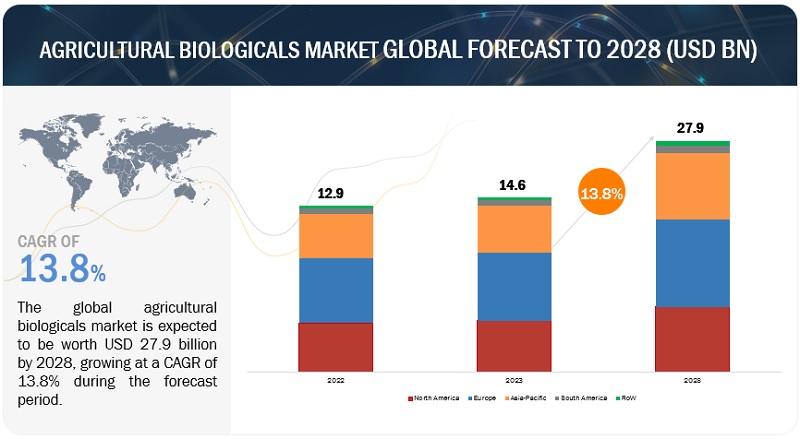
The agricultural biologicals market is set to witness substantial growth, with an anticipated size of USD 27.9 billion by 2028, reflecting a significant increase from the 2023 figure of USD 14.6 billion. This surge is attributed to a compound annual growth rate (CAGR) of 13.8% during the forecast period. The driving force behind this expansion is the increasing global demand for safer and more sustainable alternatives to chemical pesticides, as governments and regulatory bodies tighten regulations to protect human health and the environment.

Download PDF brochure: https://www.marketsandmarkets.com/pdfdownloadNew.asp?id=100393324

Governments and regulatory bodies worldwide are acknowledging the potential risks associated with chemical pesticides, ranging from adverse effects on human health to environmental concerns. The push for stricter regulations aims to limit the use and impact of chemical pesticides, prompting a significant shift in the agricultural industry. The recognition of agricultural biologicals as safer and sustainable alternatives has consequently fueled their adoption on a global scale.

The rise of Integrated Pest Management (IPM) is contributing to the growth of the agricultural biologicals market. IPM, recognized as a holistic approach to pest control, advocates for diverse strategies, including biological control methods. Agricultural biologicals play a pivotal role in promoting sustainable pest management within the framework of IPM, offering farmers effective tools to manage pests while minimizing environmental and health impacts. This trend presents substantial opportunities for the utilization of agricultural biologicals across diverse cropping systems.

The European Union (EU) has taken a forefront position in implementing stringent regulations on chemical pesticides. The Sustainable Use Directive (2009/128/EC) encourages integrated pest management practices and non-chemical methods, leading to a significant reduction in the use of chemical pesticides within European agriculture. The EU’s emphasis on biological controls has driven the adoption of agricultural biologicals in the region.

Make an Inquiry: https://www.marketsandmarkets.com/Enquiry_Before_BuyingNew.asp?id=100393324

North America is expected to dominate the global agricultural biologicals market, fueled by a high level of awareness and willingness among farmers in the United States and Canada to embrace sustainable agricultural practices. The increasing demand for organic and sustainable food, coupled with concerns about chemical pesticide use, has driven the active pursuit of alternatives like agricultural biologicals in these regions. The well-established distribution networks and marketing channels for agricultural inputs in North America have further facilitated accessibility, contributing to the robust growth of the agricultural biologicals market.

The agricultural biologicals market’s trajectory is significantly influenced by the global shift towards stricter regulations on chemical pesticides, prompting a surge in demand for safer and sustainable alternatives. As the adoption of Integrated Pest Management practices continues to rise, agricultural biologicals are poised to play a crucial role in shaping the future of pest control in agriculture, ensuring a balance between productivity and environmental stewardship.

Green Solutions: Navigating the Growth of Agricultural Biologicals

The agricultural biologicals market size is anticipated to reach USD 27.9 billion by 2028 from USD 14.6 billion in 2023, at a CAGR of 13.8% during the forecast period in terms of value.  Stricter regulations enforced by governments and regulatory bodies globally aim to safeguard human health and the environment by limiting the use of chemical pesticides. Consequently, there is a growing demand for safer and more sustainable alternatives, driving the increased adoption of agricultural biologicals across the globe.

Request Sample Pages: https://www.marketsandmarkets.com/requestsampleNew.asp?id=100393324

Agricultural Biologicals Market Driver: Stricter Regulations Drive Adoption of Agricultural Biologicals as Sustainable Pesticide Alternatives

Governments and regulatory bodies around the world are increasingly recognizing the potential risks associated with chemical pesticides. These risks include adverse effects on human health, such as pesticide residue on food, as well as environmental concerns, such as contamination of water sources and harm to non-target organisms like beneficial insects and wildlife. To address these concerns, stricter regulations are being implemented to mitigate the use and impact of chemical pesticides.

This regulatory shift has prompted a significant shift in the agricultural industry, with an increasing demand for safer and more sustainable alternatives to conventional chemical pesticides. This demand has led to the rise of agricultural biologicals as viable solutions.

Agricultural Biologicals Market Opportunity: The Rise of Integrated Pest Management: Driving Opportunities for Agricultural Biologicals

Integrated Pest Management (IPM) is gaining global recognition as a holistic approach that combines diverse pest control strategies, including biological control methods. Within the realm of IPM, agricultural biologicals play a crucial role in promoting sustainable pest management practices and reducing reliance on chemical pesticides. As the adoption of IPM practices continues to increase worldwide, it presents significant opportunities for the utilization of agricultural biologicals across diverse cropping systems. By integrating biological control agents, such as beneficial insects, microbial-based products, and plant extracts, into IPM strategies, farmers can effectively manage pests while minimizing negative impacts on the environment and human health.

Strict regulations to drive the demand for the agricultural biologicals market

The European Union (EU) has taken a leading role in implementing strict regulations on chemical pesticides. Through the Sustainable Use Directive (2009/128/EC), the EU promotes integrated pest management (IPM) practices and encourages the utilization of non-chemical methods, including biological controls. As a result, there has been a substantial reduction in the use of chemical pesticides within European agriculture, with an increased adoption of agricultural biologicals.

Download PDF brochure: https://www.marketsandmarkets.com/pdfdownloadNew.asp?id=100393324

North America is expected to dominate the market during the forecast period

The global agricultural biologicals industry has seen significant growth in North America, primarily due to the high level of awareness and willingness among farmers in the United States and Canada to adopt sustainable agricultural practices. Farmers in these regions have recognized the increasing demand for organic and sustainable food, as well as the concerns surrounding chemical pesticide use. Consequently, they have actively sought alternatives such as agricultural biologicals, which has fueled market growth.

North America also benefits from well-established distribution networks and marketing channels for agricultural inputs. The presence of established agricultural input suppliers, including distributors and retailers, has played a crucial role in making agricultural biologicals easily accessible and readily available to farmers. This streamlined distribution system has further facilitated the growth of the agricultural biologicals market in the region.

Agricultural Biologicals Market Growth Insights, COVID – 19 Outbreak, Emerging Technologies, Size, Share Analysis and Regional Forecast to 2025

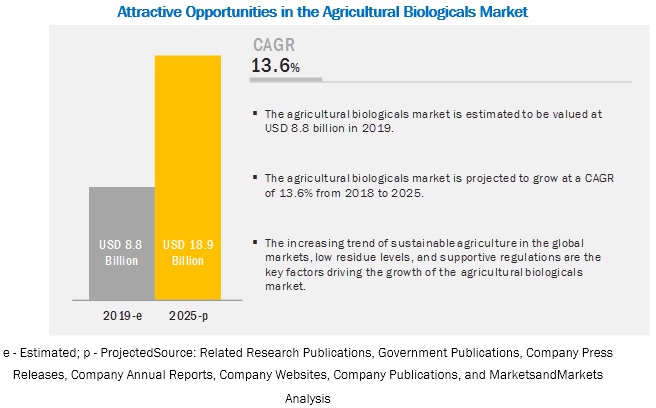
The agricultural biologicals market size is estimated to account for a value of USD 8.8 billion in 2019 and is projected to grow at a CAGR of 13.6% to reach a value of USD 18.9 billion by 2025. Factors such as the increasing trend of sustainable agriculture in the global market, low residue levels, and supportive regulations are the key factors driving the growth of the agricultural biologicals market. Expansions, new product launches, and agreements were the dominant strategies adopted by key players to capitalize on the strong market potential.

North America is projected to grow at the highest CAGR during the forecast period

The North American region accounted for the largest share in the market. This market is projected to grow at the highest CAGR during the forecast period. The largest share of the North American region is attributed to its high-end R&D infrastructure and the high number of patents received for biopesticides and biostimulants by companies based in the region.

This report includes a study on the marketing and development strategies, along with a survey of the product portfolios of the leading companies operating in the agricultural biologicals market. It includes the profiles of leading companies, such as BASF SE (Germany), Syngenta (Switzerland), Marrione Bio Innovation (US), Isagro (Italy), UPL (India), Evogene (Israel), Bayer (Germany), Vegalab (US), Valent (US), Stockton (Israel), Biolchim (Italy), Rizobacter (Argentina), Valagro (Italy), Koppert Biological Systems (Netherlands), Lallemand (Canada), Symborg (Spain), Andermatt Biocontrol (Switzerland), Seipasa (Spain), and Verdasien Life Sciences (US).

By function, the biocontrol segment is estimated to account for the largest market share, in terms of value

The product portfolio of major companies operating in the agricultural biologicals market is more focused on biocontrols due to the high demand for bioinsecticides and biofungicides for integrated pest management in developed countries. The major advantages of integrated pest management are that these are usually inherently less or not toxic than others affecting only the target pest and closely related organisms, effective in micro-quantities, and quickly kill.

The microbial segment, on the basis of product type, is estimated to account for the largest share in the agricultural biologicals market, in terms of value

The major market share of the microbials segment is attributed to the high usage of microbes in the production of biopesticides and biofertilizers, as they provide essential benefits to crops in terms of efficiency and productivity. Microbes are easy to find and cultivate on a large-scale.

Request for Customization: https://www.marketsandmarkets.com/requestCustomizationNew.asp?id=100393324

The foliar spray segment, on the basis of mode of application, is estimated to account for the largest share in the agricultural biologicals market, in terms of value

The agricultural biologicals market, by mode of application, was dominated by the foliar spray segment. Foliar application helps increase nutrient supply during the early growth stages when the root system is not well-developed. Also, the volume required for foliar application is low as compared to soil application. Farmers use the foliar mode of application to apply fertilizers on crops such as apple, grapes, pomegranate, and okra.

By crop type, the fruits & vegetables segment is estimated to account for the largest market share, in terms of value

The fruits & vegetables segment is projected to be the largest segment in the market. Fruits & vegetables are high-value crops and require higher nutrition during their growth stages. This is projected to drive the markets for biopesticides and biofertilizers, which are cheaper as compared to synthetic pesticides and fertilizers. In addition, farmers in the Asia Pacific, North American, and European regions are witnessing a rise in demand for organic agricultural products. This has encouraged the demand for agricultural biologicals in fruit & vegetable cultivation.