Feed Acidulants: The ban on antibiotic growth promoters creates a significant opportunity for feed acidification

It is well known that organic acids act as preserving agents and control the growth of certain bacteria that are widely used in the food industry. In the feed industry, acidulants are widely used for their usefulness in promoting a healthy gut by modulating the intestinal flora through their bacteriostatic and/or bactericidal effects on different types of bacteria. The acidulants used in the feed have two modes of action. The first one is the reduction of pH in the digestive tract and the second is the direct anti-microbial effect against gram-negative bacteria like E. coli.

Feed acidulants are expected to witness healthy growth and adoption during the forecast period due to the ban on antibiotics in the US and the European Union (EU), and the growing government aids or funds promoting the feed industry wellness. Furthermore, the high threat of diseases in livestock is expected to impact the market positively during the forecast period. While manufacturers are looking forward to tapping this industry, the major hindering factors are the rising prices of feed acidulants and the maintenance of the efficacy of feed acidulants due to their corrosive properties. These factors are restraining the growth of this market.

According to MarketsandMarkets, the global feed acidulants market is projected to grow from USD 2.73 billion in 2018 to USD 3.45 billion by 2023. The growth of the market is expected to be directly affected by the growth of feed additives and the increasing government aid for livestock welfare. The feed acidulants industry is projected to grow at a CAGR of 5.1% from 2018 to 2023.

Download PDF brochure @ https://www.marketsandmarkets.com/pdfdownloadNew.asp?id=268013619

What is driving the growth of the feed acidulants market?

  • High threat of diseases in livestock

The outbreak of diseases such as avian flu, BSE (bovine spongiform encephalopathy), and SARS (severe acute respiratory syndrome) not only affects livestock breeding and the economy but also poses a serious threat to human health. The emergence of swine diarrhea in the US caused significant losses to swine farmers. Countries such as China, India, and Indonesia are constantly facing outbreaks of avian flu and swine flu due to their hot and humid climatic conditions. Meat vendors, meat processors, wholesalers, retailers, and ultimately, livestock growers suffer financial losses due to the culling of disease-affected animals, which further leads to a drop in animal productivity.

The use of feed acidulants in such cases proves to be an effective medium to reduce disease outbreaks. They improve animal health, improve feed efficiency by inhibiting pathogenic bacteria growth, and reduce the risk of sub-clinical infections. The addition of feed acidulants to the feed also helps in maintaining an optimum pH in the stomach of the livestock, stimulates feed consumption, and improves protein and energy digestibility by reducing microbial competition with host nutrients and endogenous nitrogen losses. Therefore, the inclusion of feed acidulants is important for the maintenance of animal health. This is one of the major factors driving the demand for feed acidulants.

The formic acid segment is projected to be the fastest-growing in the global market, in terms of value

The formic acid segment is projected to be the fastest-growing segment during the forecast period, in terms of value. Formic acid is a colorless fuming liquid and remains soluble in water in almost all proportions. This characteristic of the acidulant enables its proper mixture in the feed, thereby allowing consistent feed formulations. While formic acid remains highly efficient in improving ATTD (apparent total tract digestibility) of protein, it also aids in improving feed efficiency.

Formic acid also acts as an ensiling agent, apart from being used for the preservation and acidification of feed mixes. While being used as an ensiling agent, formic acid supports lactic acid bacteria activity during the fermentation process. The acidulant remains particularly effective in ensiling wet and high-protein fodder plants. Additionally, the use of formic acid is known to be environmentally safe, as it decomposes after it has been used as an ensiling agent. Formic acid also boasts antibacterial effects that help to preserve the feed. Formic acid, when used in tandem with propionic acid, enhances this functionality further.

Speak to Analyst @ https://www.marketsandmarkets.com/speaktoanalystNew.asp?id=268013619
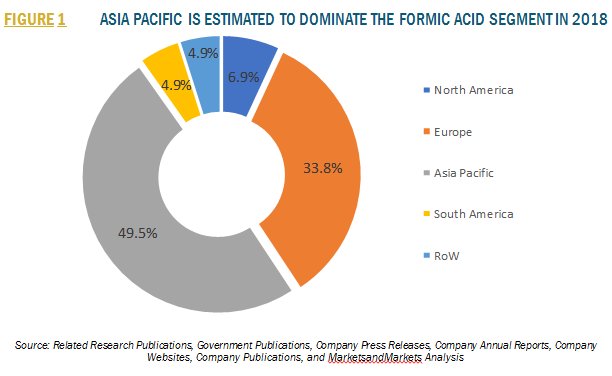
Based on region, the feed acidulants market is segmented into North America, Europe, Asia Pacific, South America, and Rest of the World.

  • South America accounted for the market size of USD 167.2 million, in the feed acidulants market in 2017. It is projected to grow at the highest CAGR of 5.6% during the forecast period. BASF SE (Denmark) and Kemin Industries Inc. (US) are the two of the prominent players present in the region.
  • Increase in annual livestock production in South America subsequently drives the demand for compound feed, which, in turn, drives the consumption of feed acidulants. The rapid expansion of the livestock industry in the region has also resulted in steady imports of feed acidulants. According to the WHO, the per capita meat and milk & dairy product consumption in South America was the highest in 2015, as compared to other regions; and this trend is expected to continue to drive the demand for feed acidulants in this region.

Beverage Flavoring Systems: Growth in Beverage Fortification Demand to Drive the Market for Advanced Beverage Flavoring Systems

Beverage flavoring systems are a mix of different components, based on natural, nature-identical, or artificial ingredients being combined to create novel flavors. Beverage flavoring systems are regarded as semi-finished products having a limited shelf life and are manufactured according to the highest quality requirements, making production procedures easier, by providing customized flavor solutions for the beverage industry.

With the growing awareness, consumers are looking for healthy alternatives with functional properties and are more inclined toward drinks with natural flavors, natural ingredients, and those that serve functional properties, while also avoiding high-sugar consumption. Natural flavors required in functional drinks should be derived and added from herbs, trees, fruits, or flowers. This promotes the growth of clean-label flavor systems with natural ingredients for various beverage applications.

Some statistics reflecting the growth in fortified drinks consumption are mentioned below:

  • According to Natural Product Insider, energy drink consumption in the US among the 27 to 37 age group population increased from 55% in 2014 to 61% in 2015.
  • According to the 2013 Energy Drinks Report published by the European Food Safety Authority (EFSA), about 41% adolescent and 52% adult population in Europe consume energy drinks during sports activities.
  • According to a report published by Beverage Industry magazine in 2017, the sales of juice concentrates in the US increased by 4.5% in 2017 as compared to 2016.

The global beverage flavoring systems market was valued at USD 3,692.2 million in 2017. It is projected to grow at CAGR of 6.1% from 2018 to reach USD 5,215.6 million by 2023. This growth is attributed to the growing demand for beverages including fortified and non-fortified drinks across the world.

The beverage flavoring systems market, by beverage type, is segmented into alcoholic and non-alcoholic beverages. The market was dominated by the non-alcoholic beverages segment in 2017. The non-alcoholic segment is projected to grow at a significant rate due to the growing consumption of carbonated soft drinks, fruit- & vegetable-based juices, and functional drinks. The carbonated soft drinks and juice industries are major application areas of flavoring systems to enhance the taste of certain drinks. Consumer demand for innovative tastes encourages flavor manufacturers to launch new flavor products. Unusual flavors such as tropical fruits, herbs & spices, floral flavors, beer-flavored non-alcoholic beverages, smoked flavor beverages, and vegan dairy flavors are receiving global attention.

Inquiry before buying @
https://www.marketsandmarkets.com/Enquiry_Before_BuyingNew.asp?id=138195769

The use of flavoring agents is estimated to dominate the beverage flavoring systems market in 2018

The various components of the beverage flavoring systems include flavoring agents such as flavors, taste modulators & taste-masking agents, flavor carriers, flavor enhancers, and other ingredients, which include curing & pickling agents, preservatives, acidity regulators, emulsifiers, and stabilizers. Flavoring agents are additives that are used to enhance and modify the flavors of beverages. These are further sub-segmented into flavors and taste modulators & taste-masking agents and are an integral part of any flavoring system. For instance, flavor masking agents are required to mask the harsh taste of functional ingredients such as proteins or high-intensity sweeteners present in the beverages. Firmenich (Switzerland) offers Mask-IT, a flavor masking agent, which can be used to mask bitterness. The flavoring agents segment accounted for the largest share of the beverage flavoring systems market.

Key Developments in the Market:

Sensient Technologies (US), Givaudan (Switzerland), International Flavors and Fragrances (IFF) (US), Firmenich (Switzerland), and Symrise (Germany) are among the key players in the market. The market players focused on various development strategies such as new product launches, expansions & investments, acquisitions, partnerships, mergers, and collaborations in the last few years to meet the growing demand for beverage flavoring systems.

Some of the major developments in the market are listed below:

  • In August 2018, ADM (US) opened its new technical innovation center in Shanghai, China, to support the development and creation of innovative and nutritious products. This center would help the company to accommodate the increasing demand for nutritional food & beverage products in the Asia Pacific region.
  • In September 2018, Givaudan (Switzerland) acquired Naturex (France), with an aim to cater to the customers across the food & beverage, nutrition, and health & personal care sectors with natural, clean labeled, and organic products.
  • In June 2018, Firmenich (Switzerland) launched its Natural and Clean Label platform through which it would provide the natural, authentic, and traceable products to gain customer and their trust.

The market for nature-identical flavoring systems is growing worldwide due to cheaper sources of these flavoring systems. Nature-identical flavoring systems are preferred by the industry, because they are less expensive than the natural ones, easily available, and have a molecular structure similar to the natural flavors. It is impossible to meet the large demand for natural ingredients due to lack of availability of required quantities. This is fueling the demand for nature-identical products in the market.

Market Drivers:

  • Growth in demand for a variety of innovative flavors in soft drinks

With the growth in the soft drinks market, the demand for innovative beverage flavoring systems is also rising at a fast pace due to consumer inclination toward innovative flavors.

Some of the latest innovative beverage flavor system launches in the market are as follows:

  • In June 2017, IFF (US) launched its Tastepoint program to offer a differentiating taste in alcoholic and non-alcoholic beverages.
    • In July 2017, Tate & Lyle (UK) launched ‘Taste for Adventure’ flavor range, which includes dark soft brown, organic dark soft brown, golden caster, organic golden caster, and demerara.
    • In June 2018, Firmenich (Switzerland) launched its natural and clean label platform through which it offers natural flavor systems for beverage manufacturers.
  • Launch of advanced technologies for flavor processing

Companies are adopting new technologies such as advanced extraction and non-thermal processes to produce better varieties of beverage flavoring systems with natural and synthetic ingredients for more stability and suitability.

Some other technologies used in beverage flavoring systems for various functions and that have fueled the market growth are as follows:

  • Dry blending
    • Retorting
    • Tunnel pasteurization
    • Spray drying
    • Agglomeration
    • Encapsulation
  • Consumer inclination toward clean-label and organic products

The growth in demand for plant-based or natural origin flavor systems is attributed to consumer awareness about clean-label products. This has led beverage manufacturers to adopt flavor systems incorporated with clean-label ingredients. According to a study published by the Journal of Food Science in 2017, consumers are willing to pay more for food products labeled as “all-natural” as compared to products without labels. This factor fuels growth of the beverage flavoring systems market players to launch innovative natural products.

Speak to Analyst @ 
https://www.marketsandmarkets.com/speaktoanalystNew.asp?id=138195769

Asia Pacific is projected to dominate the market through 2023

The Asia Pacific market dominated in 2017 due to the increasing demand for carbonated soft drinks across the region. The region is an emerging market with investments from several multinational manufacturers, especially in countries such as China, India, and Japan; these are the major markets in the region. According to the World Economic Forum, the per capita consumption of carbonated soft drinks has been increasing in India, which is a potential market for carbonated soft drink flavor system manufacturers.